
Home »
THEMATIC AREA
Humanitarian aid and development
Response in humanitarian crises is the result of a complex system in motion: actors, principles, standards, lessons learned, coordination mechanisms, and resource mobilization. This system has been built, reshaped, and improved over decades. Understanding it is key for anyone who wants to work in it and develop humanitarian projects in the midst of conflicts and emergencies.
7
areas
32
pages
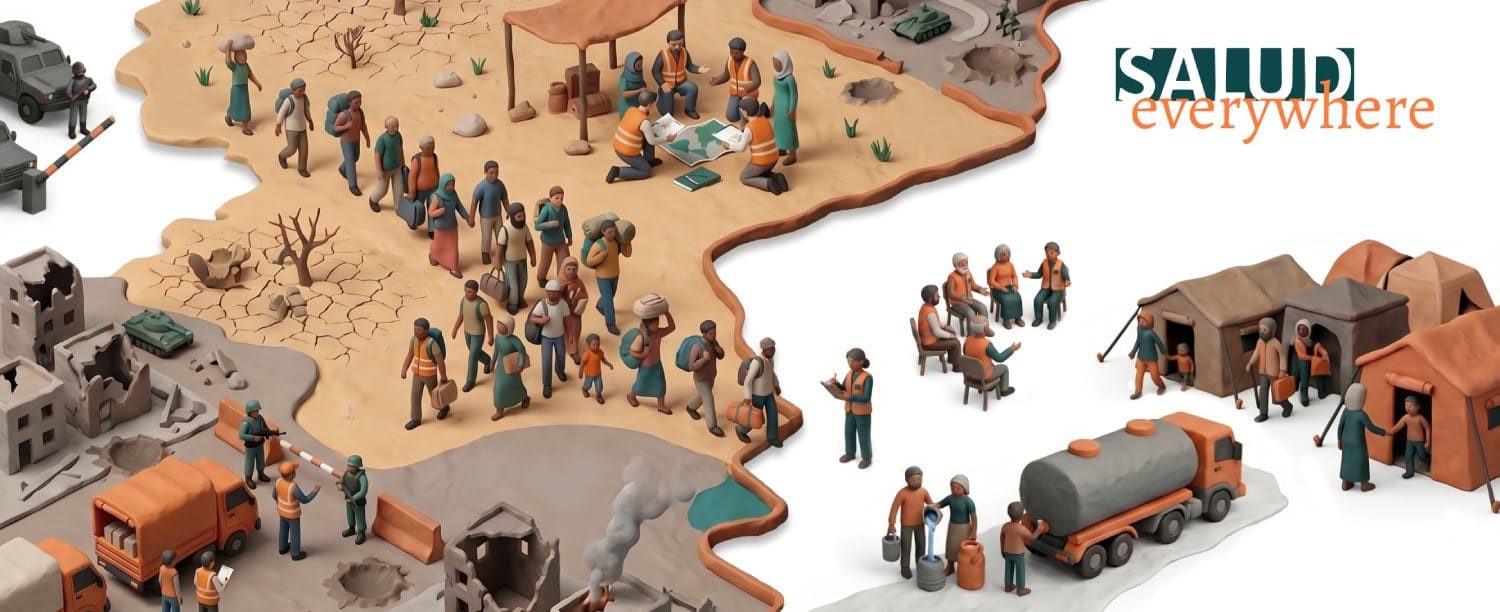
Humanitarian action: what is it, where does it come from and how is it organised?
When emergencies and humanitarian crises occur, humanitarian action intervenes to alleviate human suffering. What today seems self-evident is the result of a long historical process that built a system with its own ethical foundations, a complex institutional architecture and a specific way of operating.
- Humanitarian action is guided by four principles: humanity, impartiality, neutrality, and independence. They distinguish it from other forms of international cooperation.
- It operates in specific contexts of disasters, conflicts and displacement.
- Humanitarian action differs from development cooperation in its timeframes, principles, objectives, and types of action, although in protracted crises the lines between the two often become blurred.
5 pages
→ Read more.
- The modern humanitarian system was born in 1863 with the creation of the ICRC and the first Geneva Conventions, and continued to build its foundations during the major conflicts of the twentieth century and the Cold War.
- Key initiatives emerged from the evaluation of the humanitarian response in Rwanda in 1994. Reforms continued in 2005, 2011 and 2016.
- In 2025, a major humanitarian funding crisis occurred, accelerating hyperprioritisation and new changes in the humanitarian system.
7 pages
→ Read more.
- The humanitarian system brings together national authorities, United Nations agencies, local and international NGOs, the Red Cross and Red Crescent Movement, and governmental donors, who mobilise and activate when a crisis occurs.
- Coordination is organised around the Emergency Relief Coordinator, the IASC and OCHA at global level, and the Humanitarian Coordinator and clusters at national level.
- Humanitarian funding has always been insufficient, unequal, and structurally fragile. These weaknesses were fully exposed in 2025.
4 pages
→ Read more.
How is a quality humanitarian response put into practice?
Dar una buena respuesta a una crisis humanitaria requiere gestionar cada intervención a lo largo de todo su ciclo, desde el análisis de necesidades hasta la evaluación; hacerlo conforme a estándares de calidad y rendición de cuentas ante las comunidades; garantizar la seguridad del perosnal y el acceos a la población en contextos cada vez más hostiles; y no perder de vista temas como la igualdad de género, la protección o la salud mental, que deben considerarse en cualquier intervención.
- Standards such as the Sphere Project and the Core Humanitarian Standard (CHS) define what a dignified, safe and quality response looks like, and set out accountability commitments to communities.
- The humanitarian system has spent decades promising to return power, voice and resources to affected communities and local actors, but the real power dynamics have barely changed.
- Accountability to donors still weighs more heavily than accountability to affected people.
4 pages
→ Read more.
- Attacks on aid and health workers have reached record highs, in a context of growing impunity.
- Humanitarian space is shrinking due to violence, the politicisation and instrumentalisation of aid, sanctions, counter-terrorism measures and countless administrative barriers.
- To keep delivering assistance without compromising their neutrality, organisations combine security strategies (acceptance, protection and deterrence) with humanitarian diplomacy.
3 pages
→ Read more.
- A large part of humanitarian action is structured and channelled through projects.
- A humanitarian and development project is a set of planned actions with a clear internal logic connecting resources, activities, results and impact.
- Anyone who wants to work in the sector needs to understand this logic and its phases, including context analysis and needs assessment, project design and formulation, implementation, and monitoring, evaluation and learning.
5 pages
→ Read more.
- Crises exacerbate pre-existing inequalities, destroy support networks and expose people to risks that go far beyond the immediate emergency. Ignoring this can be a source of additional harm.
- For this reason, any humanitarian intervention must integrate aspects related to gender equality, mental health and psychosocial support, the environment and protection, among others.
- They must be taken into account from context analysis through to evaluation and across all technical sectors.
4 pages
→ Read more.