
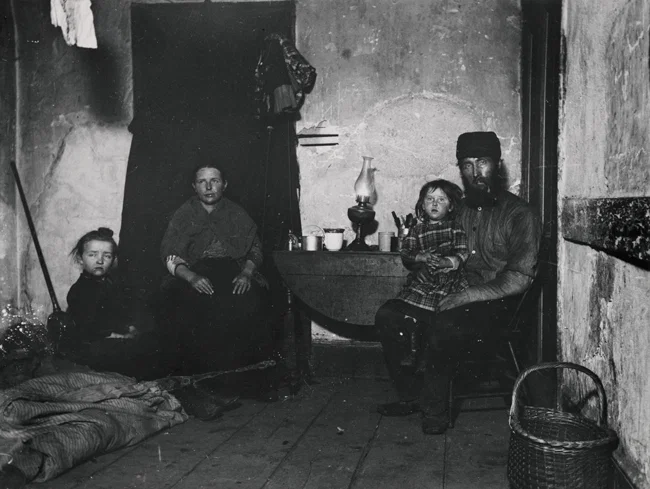
There was a time when not everything had already been photographed to saturation point. When one didn't live bombarded by mountains of sensationalist headlines about every single thing that happened. A time when, although every effort was made to inform, today's media were still in their infancy. Photojournalism was taking its first steps (despite the absence of megapixels, ultrasonic autofocus and smile detectors), and good photographs still drew rounds "oh"s of admiration from the mouths of those who, for the first time, were being invited to see beyond their own noses.
And it's in this period that we meet Jacob Riis, a Danish emigrant who landed in New York in 1870. With the American Civil War over, millions of people were migrating to the big cities, and thousands crowded into the neighbourhoods of what is now Lower Manhattan. Within a few years he began working as a reporter for several city newspapers, covering news and incidents in the slums.
The rich knew the reality of the rich, and the poor knew the reality of the poor. Few of the former, precisely the ones who held power, ventured to set foot among the latter. Poverty could be seen and smelled, but only from a distance, with little real knowledge of the living conditions in the most deprived neighbourhoods.
And there was light...
Despite the many difficulties, Jacob Riis set out to go straight into the heart of it and capture it, with an old glass-plate camera. The light bulb had yet to be commercialised, and taking a photograph inside a home with a camera like this was next to impossible.
However, around that time, some Germans were experimenting with a dangerous mixture of magnesium and potassium chlorate, fired from a cartridge pistol, capable of producing small explosions that released a great burst of light. Flash photography was taking its first steps, and Jacob Riis was possibly the first to use it in photojournalism. He went into the overcrowded homes of the immigrant neighbourhoods with a few assistants and took stacks of photographs. That is how flash, an artificial manipulation of light, made it possible to show what was there, invisible to the naked eye.
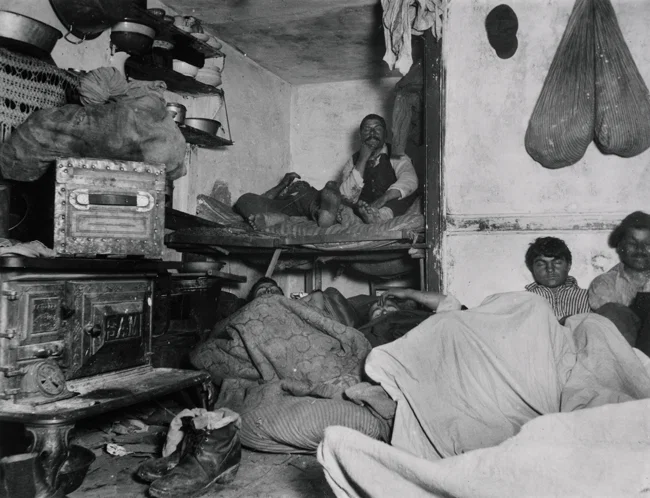
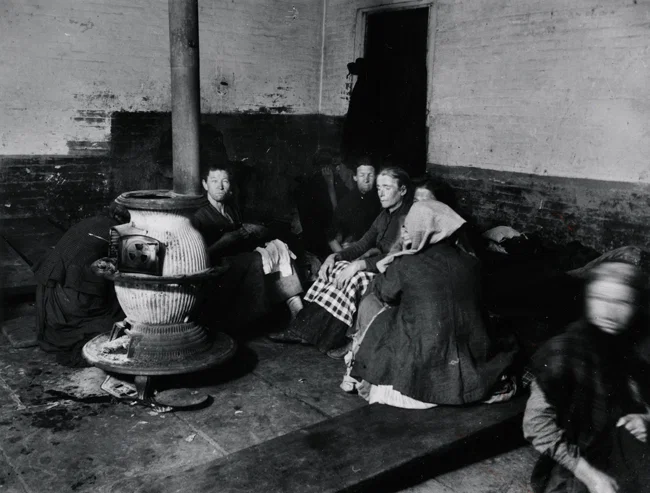
...and revealed the social determinants of health
The publication of these photographs in 1889, alongside the famous essay "How the Other Half Lives", left the city's middle and upper classes far from indifferent. Although it portrayed some poor people as good (and victims) and others as bad (and culpable, as idlers and criminals), what Riis did achieve was to demand better living conditions for everyone, along with proper hygiene and sanitation measures and adequate social services.
The problems he exposed and the reforms he proposed came to influence the city's political agenda and figures such as Theodore Roosevelt, who a decade later would become President of the United States.
In 2008 Jonas Bendiksen also showed the reality of the other half of the world that we still don't see.
All of this happened 135 years ago, but although globalisation has allowed us to glimpse the other side of the world, we haven't narrowed the distances that much, nor changed things that much, nor changed health in cities that much. The other half is still the other half. Back then it was the slums of New York, and today it's the shanty towns of half the world.
Jonas Bendiksen published "The Places We Live" in 2008, showing the reality of the homes of millions of people in Venezuela, Indonesia, Kenya and India. His work, presented in an essential book, should still leave us open mouthed, and remind us that we cannot talk about public health without looking directly at reality, up close, and without sugarcoating it.
Note
I wrote this article in 2011, on what was then my personal blog, now gone. It seemed like a good idea to bring it back now for Salud Everywhere. I remembered it after leafing through Bendiksen's book yesterday, which has pride of place on my shelf.
The photographs in this article are the work of Jacob Riis (1889) and are in the public domain. Unlike the other images on Salud Everywhere, they are not my own.
Blog
The blog posts in Salud Everywhere expand its content on humanitarian aid and cooperation, health in humanitarian crises and career advice with news, opinion and analysis.
External links
- Jacob A. Riis, 1889. How the other half lives.
- Jonas Bendiksen, 2008. The Places We Live.