
What is a famine? What causes it and how one is declared
- Page updated onSeptember 9, 2026

Since the standardized system for classifying famines was established in 2004, only five have been declared. Unfortunately, this is not because extreme acute food insecurity, malnutrition, and mortality have disappeared, but because confirming it is technically very difficult. Furthermore, declaring a famine often depends on the very parties responsible for causing the humanitarian crisis.
Furthermore, talking about famine is not the same as talking about hunger or food insecurity. This page clarifies the international technical criteria for confirming a famine.
Table of contents:
The difference between famine and food insecurity
How is food security classified?: the IPC scale
There are several ways of measuring food security. One of them is the FIES scale, centred on the food insecurity experience of those surveyed. Another is the Integrated Food Security Phase Classification (IPC) (IPC, 2024). This is an initiative by a group of international actors to guide policies, programmes and emergency humanitarian responses.
The IPC is not a single measure. It is a framework that includes several related classifications, such as the IPC for Acute Food Insecurity, the IPC for Chronic Food Insecurity, and the IPC for Acute Malnutrition.
Of the three IPC scales, the most widely used is typically the acute food insecurity one, given its potential for analysing the level of need in humanitarian crises and informing rapid response decisions. It is calculated on the basis of expert analysis and consensus on several outcome and context indicators. These include food availability, access, consumption, food system stability, unsustainable coping strategies, malnutrition and mortality (IPC, 2021).
As a result of technical consensus among analysts, the IPC scale establishes five possible levels of acute food insecurity: (1) minimal or none, (2) stressed, (3) crisis, (4) emergency, and (5) catastrophe or famine. This classification applies to both households and areas. Essentially, an area is classified in a specific phase when at least 20% of households are in that phase or in more severe phases.
A famine is a state of extreme food insecurity, coupled with acute malnutrition and excess mortality
A famine corresponds to a situation in which three conditions occur simultaneously (IPC, 2025a):
- The proportion of households in IPC Phase 5 for acute food insecurity exceeds 20%. In other words, one in five households faces an extreme lack of food.
- The prevalence of acute malnutrition in children under five years of age reaches or exceeds 30% (measured by weight-for-height index) or 15% (measured by MUAC).
- The crude death rate reaches 2 deaths per 10,000 people per day, or 4 deaths per 10,000 children under 5 years of age per day, due to starvation or the interaction between malnutrition and disease.
All these conditions are necessary, but not sufficient. This means that if only the first condition is met, it can be said that more than 20% of the population is in Phase 5 (catastrophe), but the area could not be officially classified as a famine. If the thresholds of two of these three conditions have been exceeded, and it is believed that the third is also likely to have been exceeded, this is referred to as a famine with reasonable evidence. If there is clear and convincing evidence that all three thresholds have been reached, this is referred to as a famine with solid evidence.
It is also important to note that this system is only a technical classification. When a national analysis suggests a possible famine, the Famine Review Committee is activated, which analyses the evidence with technical rigour and confirms the findings. This is what enables governments and international agencies to make a formal famine declaration; the responsibility for doing so rests with them. The declaration helps to raise the visibility of the crisis, mobilise funding to respond to it, and even bring about policy changes (World Hunger Education Service, 2024).
A famine always requires urgent action from all parties involved to ensure humanitarian access, a rapid multisectoral response, and the cessation of conflict, if it is considered a contributing factor.
🧠 Let's pause and reflect
What is the practical operational importance of the official recognition of a famine, if other earlier indicators already justify a humanitarian response?
- 1Think and write your answer.
- 2Click on «Copy and open».
- 3Paste to receive feedback.
📚 This is the NotebookLM for this topic. It uses only carefully selected references. | What is NotebookLM?
What causes famines?
Equating famine with food insecurity is a mistake, even if it seems counterintuitive. Moreover, as the percentage of the population suffering from hunger and food insecurity decreases, the number of famines is increasing (de Waal, 2025). It is true that famines tend to affect populations in countries with the lowest food security indices, but focusing solely on this association overlooks many other causes and, above all, a fundamental factor: hunger as a weapon of war. It also fails to account for the fact that we now know that when pressure on food security increases, families adopt coping strategies. Famine only occurs when the pressure is sustained to an intolerable limit, these coping mechanisms become insufficient and the pressure accelerates its effect (Howe, 2018). For this to happen, a trigger is needed.
Experts from the World Peace Foundation studied in 2025 the 83 major famines recorded between 1870 and 2022, all of which caused more than 100,000 deaths. Their analysis of the causes revealed that the leading cause of famines is conflict, without any doubt (Day, 2025). Alongside conflict, other contributing factors include state and global policies, the climate, diseases, economic crises, and forced displacement.
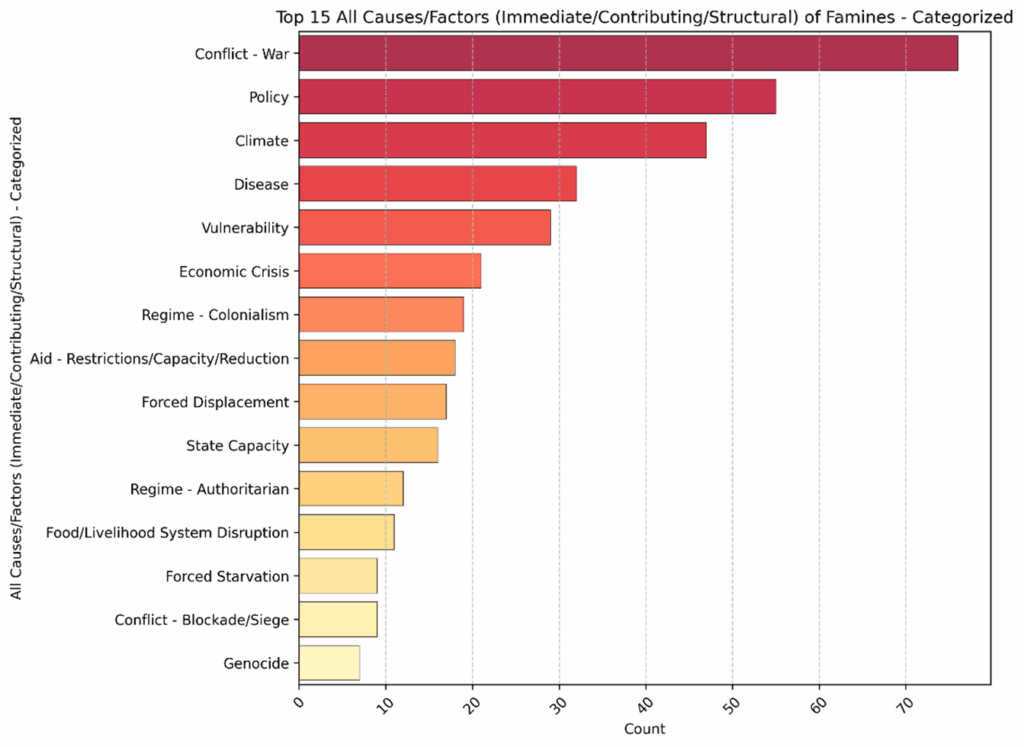
Do famines have natural causes? Yes, of course, but with important qualifications. For many centuries, famines were triggered by natural disasters such as droughts or floods, but today the situation has changed. Virtually every country in the world has experienced sufficient economic growth for a natural disaster not to cause a famine (de Waal & Bell, 2026a). In fact, since the 1980s, there has not been a single famine triggered by drought, and famines caused primarily by economic hardship have disappeared from the planet.
Since the late twentieth century, famines have been caused by conflict (de Waal & Bell, 2026b). How and when a famine develops depends on the nature of the conflict and the ways in which it exerts sustained pressure on food insecurity until a breaking point is reached, for example through sieges, isolation, or the closure of border crossings to goods and food supplies (Maxwell et al., 2026).
Since 2004, only five famines have been declared according to IPC criteria
The standardized system for detecting and classifying famines was established in 2004. Before then, of course, there had been many well-known historical famines, but none had been formally confirmed. In fact, it is estimated that, in the twentieth century alone, more than 70 million people died in the famines that occurred in China, the Soviet Union, India, Bangladesh, Ethiopia, and Sudan (Devereux, 2000).
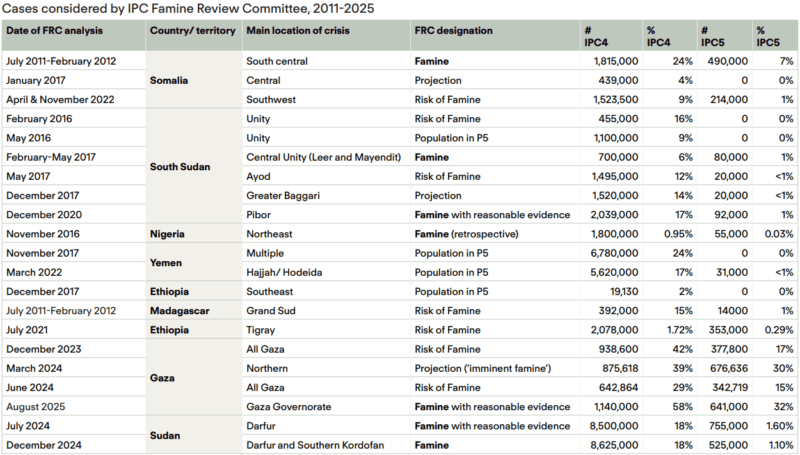
Since 2004, only five famines have been officially confirmed worldwide, having exceeded the strict thresholds established by the IPC system:
- Somalia (2011): More than 490,000 people experienced extreme acute food insecurity conditions, due to drought and conflict, in the south of the country.
- South Sudan (2017): In the central and northern parts of the country, more than 80,000 people faced famine conditions (Phase 5). A further one million people were in an emergency situation (Phase 4), following three years of civil war.
- South Sudan (2020): Famine struck the country again three years after the previous episode, as a result of conflict and flooding.
- Sudan (2024): The Famine Review Committee confirmed the famine classification at the end of the year and updated it in 2025 (IPC, 2025b), as a result of the armed conflict, the obstruction of humanitarian assistance in besieged areas, and the forced displacement of millions of people.
- Gaza (2025): The Famine Review Committee determined in August of that year, despite major technical challenges and the collapse of registration and surveillance systems, that famine was already occurring in parts of the Gaza Strip, making it the first officially confirmed famine in the Middle East (IPC, 2025c).
In any case, there have been many more instances in which the Famine Review Committee has identified a risk of famine or large numbers of people in IPC Phase 5 (World Peace Foundation, n.d.).
Why is it so difficult to declare a famine?
Declaring a famine requires a series of steps that, in complex humanitarian crises, can represent a major challenge, due to the strictness of its technical criteria and its political implications (de Zwarte et al., 2026).
First, the technical thresholds for confirming a famine are highly strict and difficult to evidence. How can the prevalence of severe acute malnutrition be measured when armed groups restrict humanitarian access, or when health information systems have collapsed? Furthermore, some of the thresholds prove inadequate for certain contexts, having been initially designed for others and not focusing on the age groups in which mortality increases the most. Mortality, moreover, is a lagging indicator. By the time it is evidenced, it is already too late to prioritise an intervention in populations that have already been living in extreme conditions for weeks or months.
Finally, the official declaration is highly politicised and easily manipulated by authorities. Why would those responsible for causing a famine want to admit that it has actually occurred and expose themselves to international pressure or sanctions? Quite the opposite. Furthermore, in conflict zones, the parties involved can easily restrict access to demographic and anthropometric data.
References
- Day, M. (2025, June 5). Historic drivers and triggers of famine: What the data shows. World Peace Foundation. https://worldpeacefoundation.org/blog/historic-drivers-and-triggers-of-famine-what-the-data-shows/
- de Waal, A. (2025, August 8). Though global food security improves, famines are more numerous: Exploring the links. World Peace Foundation. https://worldpeacefoundation.org/blog/though-global-food-security-improves-famines-are-more-numerous/
- de Waal, A., & Bell, K. (2026a, March 12). Natural disasters and man-made famines: The big picture. World Peace Foundation. https://worldpeacefoundation.org/blog/natural-disasters-and-man-made-famines-the-big-picture/
- de Waal, A., & Bell, K. (2026b, April 24). War famines: The big trends. World Peace Foundation. https://worldpeacefoundation.org/blog/war-famines-the-big-trends/
- de Zwarte, I., de Waal, A., & Lumey, L. H. (2026). Rethinking current famine classification: Insights from history. The Lancet, 407(10530), 755–757. https://doi.org/10.1016/S0140-6736(26)00214-X
- Devereux, S. (2000). Famine in the twentieth century (IDS Working Paper 105). Institute of Development Studies. https://www.ids.ac.uk/files/dmfile/wp105.pdf
- Howe, P. (2018). Famine systems: A new model for understanding the development of famines. World Development, 105, 144–155. https://doi.org/10.1016/j.worlddev.2017.12.028
- Integrated Food Security Phase Classification. (2021). Indicators utilized by IPC (Version 1). https://www.ipcinfo.org/ipcinfo-website/resources/resources-details/en/c/1154952/
- Integrated Food Security Phase Classification. (2024). The IPC communication guidelines 2024. https://www.ipcinfo.org/communicationguidelines
- Integrated Food Security Phase Classification. (2025a). The IPC famine factsheet. https://www.ipcinfo.org/famine-facts/en/
- Integrated Food Security Phase Classification. (2025b). Famine Review Committee: Sudan — Conclusions and recommendations. https://www.ipcinfo.org/fileadmin/user_upload/ipcinfo/docs/IPC_Famine_Review_Committee_Report_Sudan_Oct_2025.pdf
- Integrated Food Security Phase Classification. (2025c). Famine Review Committee: Gaza Strip — Conclusions and recommendations. https://www.ipcinfo.org/fileadmin/user_upload/ipcinfo/docs/IPC_Famine_Review_Committee_Report_Gaza_Aug2025.pdf
- Maxwell, D., Day, M., Fitzpatrick, M., Howe, P., Hailey, P., Atre, A., & de Waal, A. (2026). Trajectories into famine: Observations of patterns and implications for prevention. Food Policy, 140, 103073. https://doi.org/10.1016/j.foodpol.2026.103073
- World Hunger Education Service. (2024, December). Famine fact sheet. https://www.worldhunger.org/wp-content/uploads/2024/12/Famine-Fact-Sheet-Dec-2024.pdf
- World Peace Foundation. (n.d.). History & future of famine. https://worldpeacefoundation.org/project/history-future-of-famine/
NotebookLM
You can review my bibliographic references on famines with this NotebookLM, an AI-powered research assistant. Want to know more?
How to cite this page
Abarca, B. (September 9, 2026). What is a famine? What causes it and how one is declared. Salud Everywhere. https://saludeverywhere.com/en/health-in-humanitarian-crises/what-is-a-famine-controversies-criteria-declaration/