
Humanitarian aid and development » Humanitarian system »
Humanitarian funding: sources, mechanisms and the 2025 crisis
- Page updated onNovember 13, 2026

How humanitarian action is funded (where the money comes from, where it goes and how it gets there) largely determines the scale of the response that can be offered to crises and emergencies. Humanitarian funding mechanisms also largely shape how actions are carried out, who implements them and many of the ethical dilemmas they will have to face.
However, humanitarian funding always falls far short of covering all needs. This problem has worsened since 2023, reaching a catastrophic dimension from 2025 onwards, the year in which cuts to humanitarian action budgets plunged the sector into an unprecedented crisis, from which the channels of humanitarian funding, now severely reduced, have been fundamentally transformed.
Table of contents:
What are the main sources of humanitarian funding?
Traditionally, 80% of humanitarian funding has come from voluntary contributions from donor countries, through their international aid and cooperation agencies. The rest, around 20%, came from private donors: companies, foundations and individuals like you and me.
Among donor countries, there have always been significant disparities. Looking at the distribution of contributions, a few countries stand out above the rest. Between 2020 and 2024, on average, of all public funds for humanitarian crisis response, the United States contributed around 35.8%. They were followed at a considerable distance by Germany (11.6%), the European Commission (8.4%) and other donor countries such as Saudi Arabia (4.9%), the United Kingdom (4.7%), Japan (3.7%) and Sweden (3.1%) (OCHA, n.d.-a).
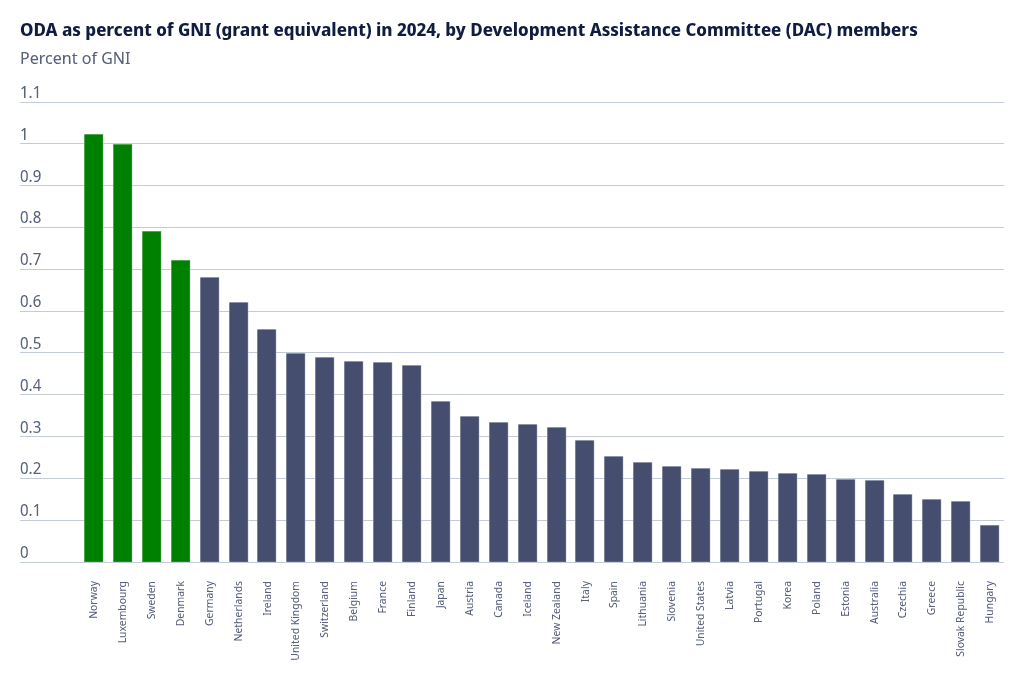
These contributions nonetheless represent a small percentage of Official Development Assistance (ODA) and an even smaller percentage of the gross domestic product of donor countries (van Teutem & Arriagada, 2025). Specifically, only between 12% and 18% of ODA is typically allocated to humanitarian action. In turn, in 2024, only four countries (Norway, Luxembourg, Sweden and Denmark) dedicated more than 0.7% of their gross domestic product to official development assistance (a voluntary commitment made in the 1970s by donor countries, though never achieved). Other donor countries, such as the United States, devoted barely 0.23% of their gross domestic product to international aid (OECD, n.d.).
Where does humanitarian funding go?
Donors can choose what their contributions are used for
The Office for the Coordination of Humanitarian Affairs (OCHA) of the United Nations and humanitarian country teams, with the support and participation of all humanitarian actors, publish key documents to guide resource mobilization and the prioritization of available humanitarian funding. These are Humanitarian Needs Overviews and Humanitarian Response Plans, along with their global versions.
Humanitarian donors are free to choose which countries, actors and interventions their contributions are directed towards. Generally, between 50% and 70% of humanitarian funding is allocated to projects aligned with the priorities of Humanitarian Response Plans, developed in a coordinated manner (IECAH & MSF, 2025).
Contributions are not distributed in proportion to the needs of different countries. Differences in the number of people who need humanitarian assistance explain only 55% of the variation in the funding received (Yuksel, 2026), while the other 45% depends on other factors such as media visibility or the political and commercial relationship with donors. Between 2021 and 2025, for example, colonial powers gave 64% more humanitarian funding to their former colonies than to other recipient countries (Yuksel, 2026).
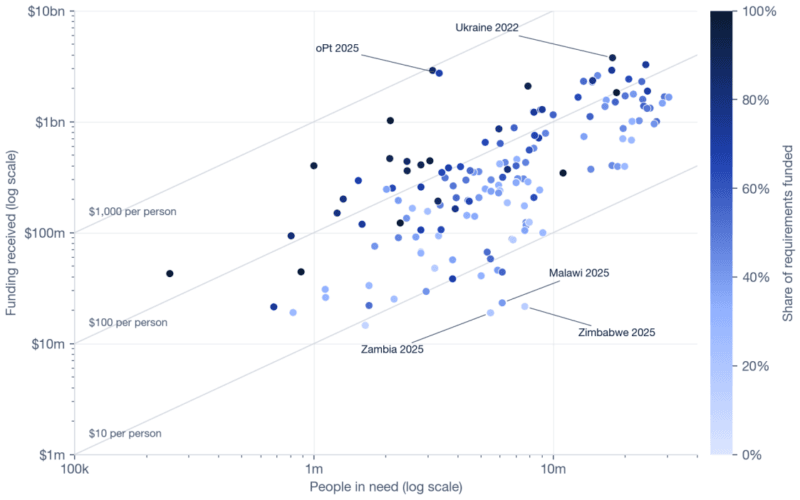
Funds mobilised are also usually not enough to cover everything required by the coordinated plans. In 2024, for example, only 51% of the amount requested in these plans was reached, and while in countries such as Lebanon, Ukraine or Sudan it exceeded 70%, in others such as Syria or Ethiopia it did not even reach 40%. In 2025, moreover, as a result of the drastic fall in humanitarian funding, barely 30% of what was required across all coordinated humanitarian response plans was achieved (Pearson et al., 2025).
Contributions are sometimes delivered directly to implementing partners selected by donors. In other cases, the international cooperation agencies of donor countries manage open calls for proposals, in which they set out their priorities, requirements and eligibility criteria. To apply, humanitarian organisations must assess the needs of the population, identify the actions needed to address them and reflect these in the proposal they submit. If they ultimately receive the funding, they must use it for what they said they would and account for it properly, in line with the donor’s rules. Between 80% and 90% of humanitarian funding is restricted (or earmarked) for exclusive use in predefined projects (Stoddard et al., 2017).
Humanitarian funding also covers indirect costs of the organizations
Most humanitarian funding mechanisms allow a small percentage of the budget to be allocated to cover indirect costs (overheads), which are needed to sustain the organisations’ general operating capacity.
Organisations need this funding to cover structural costs, deal with risks or unexpected expenses, or prepare to respond to possible crises. The percentage allocated to these overheads is usually small, at around 5-10%, although it depends on each organisation and on the agreements it reaches with donors (Girling-Morris, 2022).
When the organisation that receives the funding directly (and is responsible for using it properly and accounting for it) works with other actors as implementing partners, the funding for their overheads is negotiated between the two parties, if donors allow it. Depending on the case, implementing partners may receive additional contributions to cover these indirect costs, share the available amount with the lead partner, or include some of these expenses as direct project costs (Girling-Morris, 2022).
As is only logical, whether the funding of humanitarian organisations covers direct costs alone or indirect costs too matters a great deal. The flexibility that overheads provide largely shapes the level of autonomy and responsiveness that NGOs manage to develop (Pearson & Rieger, 2026). Donors and agencies often cut them back in the name of efficiency, however (Stoddard et al., 2017). Without these resources, NGOs, mainly local ones, are forced to pay their staff less and invest less in risk management, and they face more difficulty meeting the requirements set by other donors (Girling-Morris, 2022).
What organisations receive the funds allocated to humanitarian aid?
Although the figure varies each year, in 2024 59% of humanitarian funding was directed directly to a United Nations agency, according to the information available in OCHA's Financial Tracking Service (OCHA, n.d.-a).
Among all United Nations agencies, those that received the most funding were the World Food Programme, UNHCR and UNICEF. Together, the three received that year 75% of the funding directly allocated to United Nations agencies and 44% of total direct global humanitarian funding. It is important to understand that these agencies typically sign contracts with other international and local NGOs, which act as implementing partners and receive a fraction of the funding indirectly.
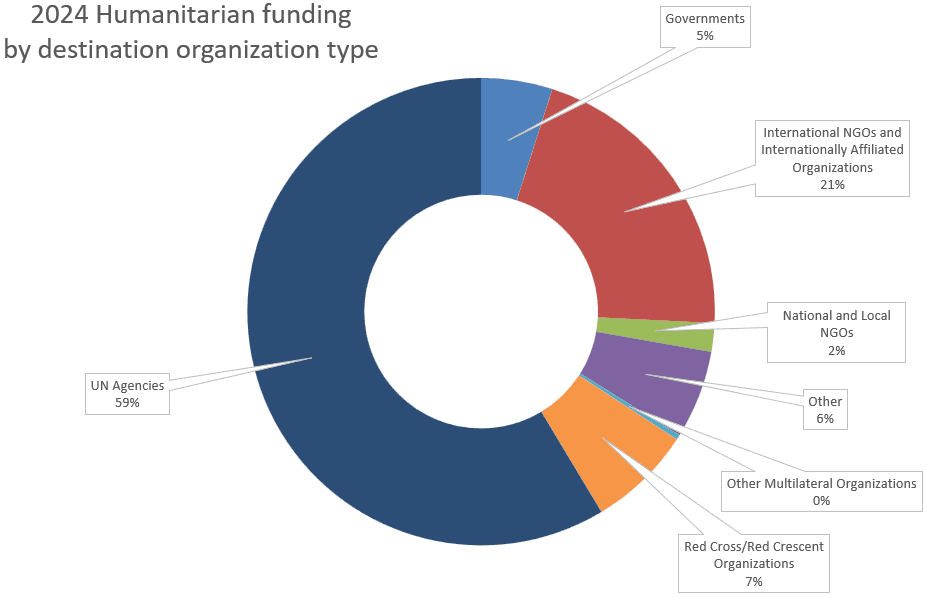
According to this same source, in 2024, 7% of humanitarian funding was directed directly to a Red Cross and Red Crescent organisation. The International Committee of the Red Cross received $1.678 billion, while the various Red Cross and Red Crescent Societies and their International Federation received a combined total of $988 million.
In 2024, international NGOs were the direct recipients of 21% of humanitarian funding (OCHA, n.d.-a):
- Three international NGOs each received more than $300 million: the Norwegian Refugee Council, Save the Children and the International Rescue Committee.
- A further 9 international NGOs received between $100 and $250 million: the Danish Refugee Council, Acted, Action Against Hunger International, Mercy Corps, CARE International, Qatar Charity, Solidarités International, Catholic Relief Services and Deutsche Welthungerhilfe.
- The majority of international NGOs received much smaller contributions.
Local and national NGOs received only 2% of direct humanitarian funding in 2024 (OCHA, n.d.-a). It is estimated that, when both direct and indirect humanitarian funding are taken into account, national and local NGOs received a total of $1.9 billion in 2024, equivalent to 5.1% of all global humanitarian funding (Pearson & Rieger, 2026).
Part of emergency response funding goes to pooled funds managed by OCHA
The pooled humanitarian funds managed by OCHA include the United Nations Central Emergency Response Fund (CERF) and the Country-Based Pooled Funds (CBPFs).
The United Nations Central Emergency Response Fund (CERF) was established in 1991 and upgraded in 2005 (United Nations, n.d.). It is a global fund managed by the Emergency Relief Coordinator (ERC) to respond quickly to acute humanitarian crises or to help finance the humanitarian response in emergencies that have not received sufficient funding through other channels. Its size was initially set at 50 million dollars a year, but it has grown progressively to reach 576 million dollars in 2024. The CERF can only directly fund United Nations agencies, although these can then subcontract international and national NGOs as implementing partners. In fact, around 25% of the CERF ends up being implemented by local NGOs.
Country-Based Pooled Funds (CBPFs), by contrast, are established when new humanitarian emergencies arise or existing ones deteriorate. They are managed by the country's Humanitarian Coordinator (HC) and are used to fund actions under the country's Humanitarian Response Plan or to respond to unforeseen emergencies (OCHA, n.d.-b). CBPFs operate in more than 20 countries, with a combined total volume that reached a peak of $1.34 billion in 2022, although the figure fell to $871 million in 2025. These funds can directly finance local NGOs without intermediaries (OCHA, 2023). In fact, the percentage of direct funding to local NGOs through these funds has increased from 26.3% in 2020 to 45.5% in 2025 (OCHA, 2025b).
Although traditionally this channel has represented only a small fraction of humanitarian funding, the situation changed drastically in 2026 (OCHA, n.d.-a). Between 2023 and 2025, only five donor countries (the Netherlands, Belgium, the United Kingdom, Ireland and Denmark) channelled more than 20% of their contributions through this route in any of those years. During those years, the United States largely ignored this channel (1.5% of all its funding in 2023 and 0.7% in 2024). However, in 2026, the United States channelled virtually all of its humanitarian funding — greatly reduced compared to previous years — through this route. Donor contributions to these funds have never been earmarked for specific projects or organisations, although the impact that the change in the United States' humanitarian funding strategy may have on this remains unknown (Loy, 2026).
What is the global humanitarian funding crisis?
The global humanitarian funding crisis is the abrupt collapse of international funds for humanitarian action that took place in 2025. That year, drastic cuts by the United States and other major donors reduced available funding by around 40%. Humanitarian funding had always been insufficient (Humanitarian Funding Forecast, 2025), but this sudden fall, at a time of record needs, overwhelmed the system's capacity to respond, giving rise to a crisis that, for many people, is also one of legitimacy of the humanitarian system itself.
A sudden and unprecedented reduction in funding
The annual volume of humanitarian financing varies from year to year. In 2016 it stood at around $22.6 billion. Thereafter, this volume increased progressively until 2021, reaching $30.9 billion. Following this, the deteriorating crises in Ukraine, Afghanistan and East Africa resulted in a sharp reversal of the trend. In response to the increased humanitarian needs of the population, annual humanitarian funding reached an all-time high in 2022: $43.3 billion.
This trend, far from being sustained, changed rapidly (Pearson et al., 2025). In 2023 and 2024, humanitarian funding fell to $37.1 billion, and in 2025 it collapsed, dropping to $27.7 billion (OCHA, n.d.-a). This abrupt reduction in global humanitarian action funding was the direct consequence of drastic cuts by several countries, most notably the United States. In just one year, this country went from contributing $14.125 billion to humanitarian action in 2024 to contributing only $3.423 billion in 2025 — a reduction of 75.8%. Other countries also significantly reduced their contributions that same year, including Germany (down 57%), the United Kingdom (down 48%) and France (down 45%) (ALNAP, 2025).
A catastrophic impact across the globe
The impact of this funding reduction has been catastrophic, and examples of this are repeated across the globe. In 2025, two famines were declared (for the first time in a century) in Gaza and Sudan, and 25 million more people than the previous year did not receive the humanitarian assistance they needed.
In countries such as Syria, efforts to move from a very prolonged humanitarian crisis to a new phase of reconstruction and recovery were frozen by the lack of funds (Islamic Relief Worldwide, 2025). At the same time, food rations for the Rohingya population in the world's largest refugee camp (Cox's Bazar, in Bangladesh) were cut by more than half (Ahmed & Shaikh Azizur Rahman, 2025).
In Lebanon, UNHCR had to abruptly announce the end of coverage for the hospitalisation costs of refugees who had arrived from Syria (UNHCR, 2025). Another example is humanitarian aid in Mozambique, which was halved between 2024 and 2025, with the population reached by humanitarian action falling by 33% over the same period (OCHA, 2025a).
The 2025 humanitarian funding crisis is also a moral and legitimacy crisis
The Emergency Relief Coordinator himself, Tom Fletcher, speaks of a crisis that is also moral and one of legitimacy in a time of global apathy, brutality, impunity and indifference (OCHA, 2025c).
This has prompted calls for an ambitious radical reform of the system (the humanitarian reset), an aggressive hyper-prioritisation of needs in the 2026 Global Humanitarian Needs Overview (OCHA, 2025c), and profound changes within humanitarian organisations (MOPAN, 2025).
🧠 Let's pause and reflect
If humanitarian funding is conditioned by the geopolitical interests of those who provide it, can the humanitarian system be truly independent, and how could this structural dependence be reduced?
- 1Think and write your answer.
- 2Click on «Copy and open».
- 3Paste to receive feedback.
📚 This is the NotebookLM for this topic. It uses only carefully selected references. | What is NotebookLM?
The 2025 humanitarian funding crisis has exposed other major chronic weaknesses in the model
It is not merely a reduction in funds. The critical widening of the gap between humanitarian needs and the money available to meet them has made evident significant flaws and limitations of the humanitarian funding model, its architecture and its mechanisms. This has been the case despite the multiple recommendations (Norwegian Refugee Council, 2024) and reforms that have been proposed over the years (Grand Bargain Caucus on Quality Funding, 2022).
Humanitarian funding has always been rigid and highly fragmented
Fragmentation of the system is a reality. Each donor country has its own mechanisms, procedures, priorities and deadlines for humanitarian funding. In addition, most calls for funding are for rapid response or have annual cycles and are tightly bounded to specific priorities, sectors, objectives and actions, defined in projects.
In most cases, the percentage of multi-year funding received by humanitarian organisations does not exceed 20% of their total (and is lower for NGOs and national and local actors). This generates a heavy workload devoted to proposal writing (of which only a portion is ultimately funded) and leaves little flexibility to plan coherent programmes in protracted humanitarian crises or to adapt a project to a changing reality (International Rescue Committee, 2020).
Humanitarian financing is unevenly distributed
On the one hand, and despite the humanitarian system's efforts to improve its coordination and the prioritization of needs-based humanitarian responses, donors continue to make a large part of their contributions according to geopolitical interests. Strategic alliances, cultural proximity or national security priorities of the most powerful governments dominate funding decisions, over humanitarian imperative and needs analyses.
On the other hand, the model prioritizes direct funding to large humanitarian actors, mainly UN agencies, ahead of international NGOs, and far ahead of national and local NGOs. This generates great inefficiencies and limits the autonomy and capacity of local NGOs, which barely manage to obtain funding indirectly, by being contracted as implementing partners. As a result, many local NGOs find it extremely difficult to sustain their basic structure, maintain the necessary capacity to identify and formulate new projects, and be able to continue competing in the next round of funding.
Previous humanitarian reforms have not achieved the changes that the model required
Both the Good Humanitarian Donorship Initiative of 2003 (Good Humanitarian Donorship, 2018) and the Grand Bargain of 2016 and its updates proposed reforms that have not been made effective. They include increasing multi-year funding, non-earmarked funding, and direct, quality funding directed to national and local actors. The need to improve the transparency, accountability and traceability of aid was also highlighted (Development Initiatives & OCHA, 2017).
However, progress has been slow and incomplete (Swithern, 2024). Some donors have increased multi-year funding, but its availability (particularly for local NGOs) remained limited even before the 2025 crisis. Likewise, improving the flexibility of aid remains an unfinished task.
These commitments were not met at the level expected in a decade of progressive increase in humanitarian funding. Now that the scenario has changed with a drastic reduction of funds and a hyper-prioritization of the most acute emergencies, priorities for new reforms also seem to have changed. Localization and strengthening and investing in Country-Based Pooled Funds seem to be key to the new agenda, as well as reducing duplication and bureaucracy, but multi-year funding takes a back seat.
At the same time, in the face of insufficient humanitarian funding, humanitarian actors are exploring alternative humanitarian financing mechanisms. These include debt-based options, loans and guarantees, which open up new possibilities, although there is skepticism about their potential and success is by no means guaranteed.
Are there innovative alternatives to traditional humanitarian funding models?
The problems of the humanitarian funding model did not emerge in 2025 but had already been studied and analysed for years (ODI, 2024). In parallel, efforts have been made to move towards new alternatives and their small-scale application. These include mainly impact funds (Farber et al., 2024), insurance-based models, crowdfunding and the application of global public-private funds for humanitarian action (Chapagain, 2023), as well as approaches to alternative donors beyond traditional Western donors, or with new narratives and messages (Pearson, 2024).
Related blog articles:
However, none of these alternatives seems sufficient or truly alternative. Many are difficult to scale, and others are complex and remain out of reach for small and medium-sized organisations. Above all, they continue to depend on the voluntary contributions of public and private donors rather than on mandatory contributions, a far more reliable foundation.
References
- Ahmed, K., & Shaikh Azizur Rahman. (2025, March 6). World Food Programme halves food rations for Rohingya in Bangladesh. The Guardian. https://www.theguardian.com/global-development/2025/mar/06/world-food-programme-food-rations-rohingya-bangladesh
- ALNAP. (2025). Humanitarian year in review: Shocks and reverberations. ODI Global/ALNAP. https://alnap.org/help-library/resources/humanitarian-year-in-review-shocks-and-reverberations-e-report/
- Chapagain, J. (2023). The untapped potential of innovative financing and humanitarian organizations. International Federation of Red Cross and Red Crescent Societies. https://www.ifrc.org/article/untapped-potential-innovative-financing-and-humanitarian-organizations
- Development Initiatives & United Nations Office for the Coordination of Humanitarian Affairs. (2017). Improving humanitarian transparency with the International Aid Transparency Initiative (IATI) and the UNOCHA Financial Tracking Service (FTS) [Background paper]. https://www.unocha.org/publications/report/world/improving-humanitarian-transparency-international-aid-transparency-initiative-iati-and
- Farber, V., Reichert, P., Martin, M., & Coderque Galligo, J. L. (2024). Humanitarian impact finance: Instruments & approaches. IMD Center for Social Innovation. https://www.imd.org/research-knowledge/finance/reports/navigating-humanitarian-impact-finance/
- Girling-Morris, F. (2022). Overhead cost allocation in the humanitarian sector [IASC Research Report]. Inter-Agency Standing Committee. https://interagencystandingcommittee.org/sites/default/files/migrated/2022-11/IASC%20Research%20report_Overhead%20Cost%20Allocation%20in%20the%20Humanitarian%20Sector.pdf
- Good Humanitarian Donorship. (2018). 24 principles and good practice of humanitarian donorship. https://www.ghdinitiative.org/assets/files/GHD%20Principles%20and%20Good%20Practice/GHD%20Principles.pdf
- Grand Bargain Caucus on Quality Funding. (2022, July). Grand Bargain Quality Funding Caucus: Outcome document. Inter-Agency Standing Committee. https://interagencystandingcommittee.org/grand-bargain-official-website/grand-bargain-quality-funding-caucus-concludes-new-funding-commitments
- Humanitarian Funding Forecast. (2025, November 21). Underfunded Crisis Index. https://humanitarianfundingforecast.org/index-underfunded-crisis/
- Instituto de Estudios sobre Conflictos y Acción Humanitaria & Médicos Sin Fronteras. (2025). La acción humanitaria en 2024-25: Un sistema en crisis, entre recortes, búsqueda de legitimidad y necesidad de reformas urgentes. https://iecah.org/informe-la-accion-humanitaria-en-2024-2025-un-sistema-en-crisis-entre-recortes-busqueda-de-legitimidad-y-necesidad-de-reformas-urgentes/
- International Rescue Committee. (2020). A win-win: Multi-year flexible funding is better for people and better value for donors. https://www.rescue.org/report/win-win-multi-year-flexible-funding-better-people-and-better-value-donors-0
- Islamic Relief Worldwide. (2025, December 5). One year on, Syria needs more international support to rebuild and recover. https://islamic-relief.org/news/one-year-on-syria-needs-more-international-support-to-rebuild-and-recover/
- Loy, I. (2026, March 16). Inklings: HNPW and the politics of pooled funds. The New Humanitarian. https://www.thenewhumanitarian.org/newsletter/2026/03/16/inklings-hnpw-and-politics-pooled-funds
- MOPAN. (2025). Mapping of multilateral organisations’ response to the current funding environment [Thematic brief: Multilateral effectiveness in a shifting landscape]. https://www.mopan.org/en/our-work/performance-insights/multilateral-effectiveness-in-a-shifting-landscape/mapping-thematic-brief.html
- ODI. (2024). Humanitarian innovative financing in fragile settings: Taking stock and charting the road ahead. ODI Global. https://media.odi.org/documents/ODI_Humanitarian_innovative_financing.pdf
- Organisation for Economic Co-operation and Development. (n.d.). Official development assistance (ODA). https://www.oecd.org/en/topics/official-development-assistance-oda.html
- Norwegian Refugee Council. (2024, July 23). Catalogue of quality funding practices to the humanitarian response (2nd ed.). https://www.nrc.no/resources/reports/catalogue-of-quality-funding-practices-to-the-humanitarian-response/
- Pearson, M. (2024, April 30). New money? What the numbers say about «non-traditional» aid donors. The New Humanitarian. https://www.thenewhumanitarian.org/analysis/2024/04/30/new-money-what-numbers-say-about-non-traditional-aid-donors
- Pearson, M., Girling-Morris, F., & Nelson-Pollard, S. (2025). Global humanitarian assistance report 2025. ALNAP. https://alnap.org/help-library/resources/global-humanitarian-assistance-gha-report-2025-e-report/
- Pearson, M., & Rieger, N. (2026). The state of international humanitarian funding to local and national actors (HPG Report). ODI Global. https://odi.org/en/publications/the-state-of-international-humanitarian-funding-to-local-and-national-actors/
- Stoddard, A., Poole, L., Taylor, G., & Willits-King, B. (2017). Efficiency and inefficiency in humanitarian financing. Humanitarian Outcomes. https://humanitarianoutcomes.org/publications/efficiency-and-inefficiency-humanitarian-financing
- Swithern, S. (2024). Revitalising the Good Humanitarian Donorship Initiative: A 20-year review. ODI Global. https://odi.org/en/publications/revitalising-the-good-humanitarian-donorship-initiative-a-20-year-review/
- United Nations High Commissioner for Refugees. (2025). Lebanon public health factsheet: January–August 2025. https://www.acnur.org/co/sites/default/files/2025-10/UNHCR%20LBN_Health%20Factsheet%20.pdf
- United Nations. (n.d.). Central Emergency Response Fund (CERF). https://cerf.un.org/
- United Nations Office for the Coordination of Humanitarian Affairs. (2023). Country-based pooled funds global guidelines. https://www.unocha.org/publications/report/world/country-based-pooled-funds-global-guidelines-enar
- United Nations Office for the Coordination of Humanitarian Affairs. (2025a). Global Humanitarian Overview 2026. https://humanitarianaction.info/document/global-humanitarian-overview-2026
- United Nations Office for the Coordination of Humanitarian Affairs. (2025b). Country-based pooled funds and regional humanitarian pooled funds 2024 in review. https://www.unocha.org/publications/report/world/country-based-pooled-funds-and-regional-humanitarian-pooled-funds-2024-review
- United Nations Office for the Coordination of Humanitarian Affairs. (2025c). Message from Emergency Relief Coordinator Tom Fletcher to the humanitarian community [Humanitarian reset]. https://www.unocha.org/news/humanitarian-reset
- United Nations Office for the Coordination of Humanitarian Affairs. (n.d.-a). Financial Tracking Service. https://fts.unocha.org/
- United Nations Office for the Coordination of Humanitarian Affairs. (n.d.-b). Country-based pooled funds. https://www.unocha.org/country-based-pooled-funds
- van Teutem, S., & Arriagada, P. (2025, April 14). What is foreign aid? How «Official Development Assistance» is measured. Our World in Data. https://ourworldindata.org/what-is-foreign-aid
- Yuksel, U. (2026, November 12). Humanitarian funding and needs, 2021 to 2025: Coverage, colonial ties and asylum. PRISM, Protection, Risk & Impact Severity Monitor. https://www.prismonitor.eu/insights/analysis/humanitarian-funding-and-needs-2021-to-2025-coverage-colonial-ties-and-asylum
How to cite this page
Abarca, B. (November 13, 2026). Humanitarian funding: sources, mechanisms and the 2025 crisis. Salud Everywhere. https://saludeverywhere.com/en/humanitarian-aid-and-international-development/humanitarian-financing/
Gemini Notebook
Explore the references for this page in this Gemini Notebook.