
From the Grand Bargain (2016) to the crisis of the humanitarian system (2025)
- Page updated onAugust 27, 2026

Following the Transformative Agenda of 2011 and up until the 2025 funding crisis, humanitarian organisations multiplied and grew, increasing their response capacity and professionalisation, while at the same time initiatives such as the Sphere Handbook and the Core Humanitarian Standard matured and consolidated.
However, these were also years marked by a rise in humanitarian needs and by grand promises of sector reform with little real change. Among these promises were those of the Agenda for Humanity and the 2016 Grand Bargain, which defined the period but without ultimately producing deep changes in the way humanitarian action was financed; nor in the real empowerment of local and national organisations, which were claiming their space and share of power within the system.
In 2025, the humanitarian funding crisis forced a contraction of humanitarian action and of the system that sustained it.
Table of contents:
The World Humanitarian Summit and the Agenda for Humanity of 2016
Although the humanitarian system was growing, it could not keep pace with rising needs
The 2010s witnessed major humanitarian crises, such as those linked to the protracted conflicts that began in Syria (2011), South Sudan (2013) and Yemen (2014), the Ebola epidemic in West Africa (2013-2016), the emergency caused by Typhoon Haiyan in the Philippines (2013), the Mediterranean Sea migration crisis, the exodus of the Rohingya from Myanmar, and the crises in Colombia and Venezuela, among others (The New Humanitarian, 2020).
Throughout the period, major migration crises occurred, fuelling numerous nationalist and populist political movements. In parallel, the humanitarian system experienced sustained growth, yet insufficient to meet humanitarian needs, which rose even further amid large, protracted civil wars (Knox Clarke, 2018).
Several new United Nations declarations and resolutions proved key in this context. Among them were the 2016 New York Declaration for Refugees and Migrants and the subsequent 2018 Global Compacts on Migration (United Nations, 2018a) and on Refugees (United Nations, 2018b). Resolution 2286 of the United Nations Security Council was also advanced, for the protection of healthcare in conflict (UN Security Council, 2016). But if anything defined the period, it was the World Humanitarian Summit and the Grand Bargain.
In 2012 the road began towards the 2016 World Humanitarian Summit and its Agenda for Humanity
In February 2012, Ban Ki-moon, then Secretary-General of the United Nations, convened the first World Humanitarian Summit, to be held in Istanbul in May 2016. He did so marking 25 years since the 1991 publication of Resolution 46/182, the basis for the formal way in which the humanitarian system began to organise itself from then on. He drew inspiration, too, from the meeting the Allied powers held in London in 1941 to commit to international cooperation (UN Secretary-General, 2016).
In preparation for this summit, Ban Ki-moon launched a consultation that, after two years of work (WHS Secretariat, 2015), culminated in a proposed Agenda for Humanity, published in February 2016. This document set out five critical areas: political leadership to help prevent and end conflicts, upholding the rules of war, leaving no one behind, shifting from a "delivering aid" approach to "ending need", and investing in humanity (UN Secretary-General, 2016). The World Humanitarian Summit of May 2016 was organised to advance the Agenda for Humanity and to promote further new commitments from all actors around its five predefined pillars (OCHA, 2016).
Of all the commitments from the 2016 World Humanitarian Summit, soon only the humanitarian-development-peace nexus and the Grand Bargain remained
Far from the inspiring changes to the humanitarian system in the 1990s, or from the concrete achievements of the 2005 humanitarian reform and the Transformative Agenda of 2011, with far more operational and concrete objectives, the proposal presented in Istanbul in May 2016 was much broader and, in a sense, diffuse. It did not aim to reach concrete commitments or to launch any kind of reform process (Knox Clarke, 2018).
Many branded the summit a missed opportunity (Bennett, 2016) and MSF, for example, walked away from it (MSF, 2016). The organisation insisted on the relevance of discussing key issues such as attacks against healthcare workers and humanitarian organisations, barriers to humanitarian access, the mistreatment of refugees and migrants fleeing war, and the weaknesses in the response to the Ebola crisis in West Africa. However, these topics were not discussed at the World Humanitarian Summit (Aly, 2016). Rather than addressing these questions from a critical analysis of mistakes and lessons learned, it merely promoted commitments as well-intentioned as they were generic and empty, minimising the responsibility of states and diluting humanitarian assistance into political and development agendas (MSF, 2016).
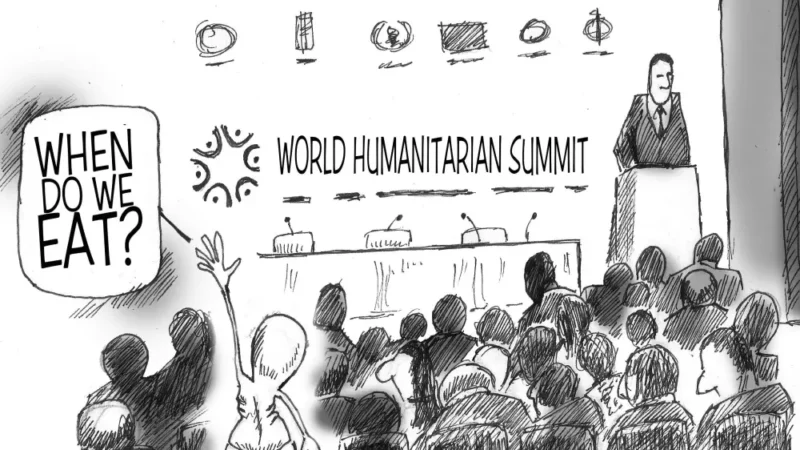
Very soon, most of these voluntary commitments, with no allocated budget or monitoring plan, faded away (Knox Clarke, 2018). Of all the ideas and commitments that fed into the Agenda for Humanity, barely any remained standing except those relating to the humanitarian-development-peace nexus, to greater support for securing the leadership of local actors, and to the responsibility of improving the financing of humanitarian action. For all this, the proposal was to sign up to a grand pact that had been put forward in January 2016 by the High-Level Panel on Humanitarian Financing, as part of the pre-summit consultations: the Grand Bargain (High-Level Panel, 2016).
The Grand Bargain: a pact between donors and humanitarian organisations
34 actors signed a mutual commitment to better humanitarian funding
The High-Level Panel on Humanitarian Financing, which had been asked to find solutions to close the gap between humanitarian needs and available resources, determined that a pact was needed between the main donors and international humanitarian organisations. This pact, called the Grand Bargain from the outset, would be based on the mutual commitment of both parties: donors were to provide more resources with greater flexibility and humanitarian organisations were to ensure more transparency and efficiency in using those resources (High-Level Panel, 2016).
The Grand Bargain was also based on voluntary commitments which, if unmet, produced no tangible consequences. However, unlike the Agenda for Humanity, which was open to everyone, the Grand Bargain was born as a table where only a select group of the powerful could sit down to negotiate: the five largest humanitarian donors and the six largest United Nations humanitarian agencies, and no one else (IASC, n.d.).
Between January and May 2016, the idea evolved, specifying the ten main points of the pact and opening up to more actors. On the day it was signed, 23 May 2016, the pact was agreed among 34 actors: 18 donors (the United States, Canada, Japan, Australia, the European Commission and 13 European countries), the World Bank, the IOM, 9 United Nations agencies, the International Federation of Red Cross and Red Crescent Societies (IFRC) and the International Committee of the Red Cross (ICRC), and 3 international NGO alliances (ICVA, InterAction and the Steering Committee for Humanitarian Response) (IASC, 2016).
The Grand Bargain took shape across 10 thematic workstreams
The pact reached among all parties took shape in 51 commitments distributed across 10 thematic workstreams (IASC, 2016):
- Greater transparency. To this end, the decision was made to invest in the development and use of the International Aid Transparency Initiative (IATI) and OCHA's Financial Tracking Service (FTS).
- Greater support and funding for local and national actors. With the aim of making humanitarian action "as local as possible and as international as necessary", several commitments were made towards localisation, including that of reaching 25% direct funding for local and national actors.
- Increasing the use and coordination of cash transfers. The Grand Bargain provided an important boost for this modality of humanitarian assistance, which was becoming increasingly relevant.
- Reducing duplication and management costs. The aim was to increase the share of funding directed straight to the benefit of people affected by crises and to introduce technological innovations that would help increase the efficiency of aid.
- Improving impartial and joint needs assessments. The pact sought to build on the efforts begun in the preceding years to improve the quality and coordination of needs assessments, so that they would genuinely support strategic decision-making about which emergencies and responses needed more resources.
- A participation revolution. The proposal was to advance the Core Humanitarian Standard, published just two years earlier, together with further initiatives to increase community dialogue, the inclusion of people affected by humanitarian crises in decision-making, and accountability.
- Improved quality funding with more multi-year funding. This reflected one of the great historical demands of humanitarian organisations, especially in contexts of protracted crises and for responses with a broad time horizon.
- More flexible quality funding with fewer restrictions. The other major funding-related demand concerned having funds that were less earmarked for a specific predefined use, and investing in contributions that humanitarian organisations could redirect swiftly in volatile contexts according to the priorities identified over time.
- Harmonising and simplifying reporting requirements. It was recognised that these requirements had multiplied and lost efficiency as the number of links in the chain grew, passing through national and international NGOs, United Nations agencies and finally institutional donors.
- Improving collaboration between humanitarian and development actors. Contributions to the Sustainable Development Goals were seen as capable of helping to reduce humanitarian needs, while it was also possible to invest in humanitarian action that would help increase the resilience of populations to potential new crises and risks without sacrificing humanitarian principles, thereby advancing the humanitarian-development-peace nexus approach.
The Grand Bargain was a structured initiative with regular monitoring and uneven progress
The Grand Bargain was not limited to an initial list of commitments. Although they were voluntary and the pact contemplated no sanctions for non-compliance, mechanisms were established for regular monitoring of the progress achieved. To this end, the Humanitarian Policy Group (HPG) at ODI was commissioned to carry out an independent annual evaluation (Metcalfe-Hough et al., 2021). These and other analyses showed how some areas saw more progress than others, after a start weighed down by new bureaucracy (Redvers, 2017).
Among the positive aspects identified in the first five years since the pact was signed were achieving more signatories (reaching a total of 63) and creating a platform for collaboration and problem-solving with all of them. In addition, considerable progress was made with cash transfers, and the tools and procedures for carrying out needs assessments and harmonised reporting were improved. There was also progress, though insufficient, on localisation and on the introduction of gender equality and the empowerment of women as a new cross-cutting theme.
Other thematic areas, however, advanced less or failed to overcome the barriers to change. For example, despite some initiatives, hardly any greater transparency was achieved regarding the use and impact of funding. Nor were significant problems in coordinating cash transfers resolved, and there were barely any changes to funding mechanisms. Other aspects, such as increasing participation or examining how to reduce management costs, were also almost forgotten.
From the Grand Bargain to the Grand Bargain 2.0 and the Grand Bargain beyond 2023
In 2021 the Grand Bargain was reviewed and redefined in a second version of the global pact: the Grand Bargain 2.0. In this update, the agreement between donors and humanitarian organisations, now with greater participation from local and national actors, set as its objective greater effectiveness, efficiency and accountability of humanitarian aid. At the same time, attention was focused on fewer key priorities: the quality of funding and support for securing the leadership and capacity of local actors and for increasing the participation of affected communities (IASC, 2021).
The update retained many of the thematic areas of the previous agreement and highlighted gender and improved shared risk management as cross-cutting themes of humanitarian reform. It also established a simpler way of organising and of working on advocacy with actors key to change.
In 2023 the agreement's priorities and its coordination and governance structures were reviewed once again, with a view to completing a decade of work. To the previous priorities was added the strengthening of the humanitarian-development-peace nexus for preparedness and rapid response to future crises and to support recovery in protracted crises (IASC, 2023).
The lack of consequences for unmet commitments held the Grand Bargain back
Although the Grand Bargain went further than the Agenda for Humanity and its hundreds of commitments, the years showed that making ambitious promises is not enough. The pact served to put the spotlight on important weaknesses and reform priorities of the humanitarian system, but it did not go on to produce the changes it needed (Loy, 2024).
Why, ten years after the Grand Bargain, had the commitments agreed upon not been met? Possibly because achieving them required making significant changes within large organisations and redistributing power, with no real incentives to do so and no repercussions for not doing so (Gérard, 2026). Giving more power and resources directly to local organisations is something many international organisations and donors support, but only until it touches their own interests and forces them to take on new risks.
The rise of national humanitarian organisations and the leadership of communities
Beyond the commitments of the Grand Bargain, many NGOs mobilised during this period to promote the leadership of local and national organisations within the humanitarian system and in responses to crises and emergencies.
The creation of NEAR, a network of Global South NGOs
The central initiative to boost national and local organisations came from the Global South, when Degan Ali, director of Adeso, a Nairobi-based NGO founded in 1991, founded NEAR (Network for Empowered Aid Response). It was 2012, and a group of leaders of local and national NGOs from different countries in the Americas, Africa and Asia, present at a meeting of ICVA (International Council of Voluntary Agencies) in Geneva, did not feel represented in a global network that included both international and national NGOs but had been born in Europe. Moved by a sense of not belonging to Global North institutions such as this one, Ali began to develop the idea of building a global network for Global South NGOs (Ali, 2026).
It was no easy task. Adeso had no funds of its own or flexible funding that would allow it to invest in the initiative, so carrying out a feasibility study for NEAR or building relationships with other national and local NGOs, which likewise had no funds of their own to take part in meetings for this purpose, proved a considerable challenge. Despite everything, NEAR was launched on 22 May 2016, the day before the World Humanitarian Summit, and literally from the very first day of its creation it advocated for a greater share of direct funding for national and local NGOs.
Other local and international initiatives for humanitarian localisation
NEAR was not the only Southern network created during this period. In 2018 A4EP (Alliance For Empowering Partnerships) also emerged, with the purpose of increasing the representation of local and national actors in spaces for discussion and decision-making on international humanitarian policy (A4EP, n.d.).
Many international NGOs also demonstrated their commitment to giving greater voice and power to national and local NGOs. For example, Oxfam US provided the US$50,000 that Adeso needed to launch NEAR (Ali, 2026). Likewise, many international NGOs considered and took on commitments to change and make fairer their way of working with national actors. These added to those of the Grand Bargain, but also included a commitment to greater transparency around the funding of local NGOs, to reducing the drain of talent from local NGOs towards international NGOs, and to facilitating their co-leadership role in jointly implemented projects (Charter4Change, 2015). Initiatives were also developed that sought to identify key elements for fairer collaboration between organisations (Christian Aid et al., 2019).
The COVID-19 pandemic and the restrictions it imposed on the movement of international organisations, as well as the growth of Country-Based Pooled Funds in various countries, also helped national and local NGOs to access more humanitarian funding, although the power imbalance persisted, with barely any change at the global scale.
From the peak to the crisis of the humanitarian system in 2025
The humanitarian system kept growing, while carrying deep internal weaknesses
The humanitarian system grew in the first decades of the 21st century, continued to structure itself around the foundations laid by the United Nations, innovated in the way it operated and responded to crises and emergencies, and became more professionalised. However, it was unable to correct the problems it had itself identified, nor to change fast enough to meet the humanitarian needs of a world that was changing more quickly (Obrecht et al., 2022).
The COVID-19 pandemic was a major blow to global health and the economy. It also shook the humanitarian sector, driving significant changes in digitalisation and a greater delegation of functions to local and national actors, without this translating into a greater share of power or direct funding for them. Thus the humanitarian system was growing, but asymmetrically, consolidating the market logic of an "industry" subject to supply and demand and to competition between service providers (Collinson, 2016), while dragging along deep unresolved problems of internal coherence and legitimacy.
The Flagship initiative: a new failed proposal and what its failure reveals
In 2023, and with the aim of "renewing humanitarian action from the bottom up", Martin Griffiths, the then Emergency Relief Coordinator, launched the Flagship Initiative in 4 pilot countries (Colombia, Niger, the Philippines and South Sudan). It was a three-year proposal to learn how to redesign humanitarian action built around the priorities identified by communities affected by crises. A coalition of humanitarian actors would then be formed to programme and plan their actions on the basis of those priorities from the local level, covering both emergency response and the strengthening of resilience, and with less bureaucratic processes (OCHA, n.d.).
The initiative produced numerous tools, lessons learned and recommendations, although it did not manage to demonstrate how to build and operate a new resource-mobilisation system. In some cases it even produced disillusionment and anger in the communities, when the projects ultimately proposed were not faithful to what had been prioritised in the participatory spaces. Even in the cases where the initiative worked, it failed to generate the conditions needed to grow and sustain it (Sida et al., 2026).
In any case, what the failure of the Flagship Initiative reveals is not practical and operational mistakes, but the system's limitations in correcting its own failures. Its final evaluation, published in March 2026, was highly critical of a humanitarian system that, over 20 years, had failed in each and every one of its attempts to reform and improve itself (Sida et al., 2026). The reasons were many and opened up uncomfortable questions: is it possible to change something that a large part of those who make decisions in the humanitarian system already take to be good or valid? Is humanitarian action compatible with open consultations and "revolutions" in community participation? Do we really need new reforms and analyses of the problems, when we have not managed to learn from what we have already done and studied? Is OCHA really the organisation that can lead the change the humanitarian system needs? Does a humanitarian system as such really exist, when the experience and learning of some organisations are seen as insufficiently legitimate by others?
All these problems resulted in a major crisis in the humanitarian system when, from 2024 onwards and, above all, from 2025, the funding available for international cooperation, global health and humanitarian action contracted.
The 2025 humanitarian funding crisis pushed the humanitarian system to the brink
At the beginning of 2025, the new United States administration temporarily paused all projects funded by USAID, which was responsible for approximately 40% of global public humanitarian funding. Days later, further orders followed to definitively terminate most of the projects funded by this agency, as well as to suspend, temporarily or permanently, the contracts of most of its staff.
The dismantling of USAID forced the plans to simplify and streamline the humanitarian system to accelerate. The worst forecasts had come true, meaning that, at the start of the second quarter of 2025, the humanitarian system found itself in the greatest funding crisis in its history.
Practically all humanitarian organisations tried to adapt to the new situation while rethinking how to continue guaranteeing humanitarian assistance in the most vulnerable contexts. The United Nations and OCHA responded with an aggressive hyper-prioritisation of the 2026 Global Humanitarian Overview and a proposal for a reset of the humanitarian system, seeking a simplification of coordination models, greater power for local and national actors, greater efficiency and the defence of the humanitarian space in which humanitarian organisations can operate safely while respecting humanitarian principles (Fletcher, 2025).
The Humanitarian Reset initiative, however, is also criticised for replicating the known mistakes of previous reforms, without changing the rules of the game, centralising its leadership in those who have led and skewed the system for years (Rey Marcos, 2023), and without granting greater voice to the communities and local actors to which the humanitarian system owes an already historical debt (Gérard, 2026). More and more voices insist that what the humanitarian system needs is not another top-down reform attempt, but a profound transformation in its power dynamics (Spiegel et al., 2026).
References
- Ali, D. (2026, August 18). Build your own house — Part 1. Substack. https://deganali.substack.com/p/build-your-own-house
- Alliance for Empowering Partnership. (n.d.). Alliance for Empowering Partnership. Retrieved August 26, 2026, from https://a4ep.net/
- Aly, H. (2016, May 26). The World Humanitarian Summit: Winners and losers. The New Humanitarian. https://www.thenewhumanitarian.org/2016/05/26/world-humanitarian-summit-winners-and-losers
- Bennett, C. (2016, May 25). World Humanitarian Summit: Political breakthrough or fringe festival? Overseas Development Institute. https://odi.org/en/insights/world-humanitarian-summit-political-breakthrough-or-fringe-festival/
- Charter4Change. (2015). Charter4Change: Localisation of humanitarian aid. Retrieved August 26, 2026, from https://charter4change.org/
- Christian Aid, CARE, Tearfund, ActionAid, CAFOD, & Oxfam. (2019). Accelerating localisation through partnerships: Recommendations for operational practices that strengthen the leadership of national and local actors in partnership-based humanitarian action globally. https://reliefweb.int/report/world/accelerating-localisation-through-partnerships-recommendations-operational-practices
- Collinson, S. (2016). Constructive deconstruction: Making sense of the international humanitarian system (HPG Working Paper). Overseas Development Institute. https://odi.org/en/publications/constructive-deconstruction-making-sense-of-the-international-humanitarian-system/
- Fletcher, T. (2025, March 10). The humanitarian reset: ERC letter to IASC Principals. Inter-Agency Standing Committee. https://interagencystandingcommittee.org/inter-agency-standing-committee/humanitarian-reset-erc-letter-iasc-principals
- Gérard, A. (2026, May 21). What blocks reform? There are 10 years of lessons for the humanitarian reset. The New Humanitarian. https://www.thenewhumanitarian.org/opinion/2026/05/21/what-blocks-reform-there-are-10-years-lessons-humanitarian-reset
- High-Level Panel on Humanitarian Financing. (2016). Too important to fail: Addressing the humanitarian financing gap — Report to the United Nations Secretary-General. United Nations. https://digitallibrary.un.org/record/830113
- Inter-Agency Standing Committee. (2016). The Grand Bargain: A shared commitment to better serve people in need. https://interagencystandingcommittee.org/sites/default/files/migrated/2016-10/grand_bargain_final_22_may_final-2.pdf
- Inter-Agency Standing Committee. (n.d.). About the Grand Bargain. Retrieved July 16, 2026, from https://interagencystandingcommittee.org/about-the-grand-bargain
- Inter-Agency Standing Committee. (2021). The Grand Bargain 2.0: Endorsed framework and annexes. https://interagencystandingcommittee.org/grand-bargain-official-website/grand-bargain-20-framework-and-annexes-deenesfr
- Inter-Agency Standing Committee. (2023). The Grand Bargain 3.0. https://interagencystandingcommittee.org/grand-bargain-official-website/grand-bargain-30-deenfr
- Knox Clarke, P. (2018). The state of the humanitarian system (SOHS) 2018 — Full report. ALNAP. https://alnap.org/help-library/resources/sohs-2018-full-report/
- Loy, I. (2024, October 15). Why the Grand Bargain’s future hinges on accountability. The New Humanitarian. https://www.thenewhumanitarian.org/news/2024/10/15/why-grand-bargain-future-hinges-accountability
- Médecins Sans Frontières. (2016, May 5). MSF to pull out of World Humanitarian Summit [Statement]. https://www.msf.org/msf-pull-out-world-humanitarian-summit
- Metcalfe-Hough, V., Fenton, W., Willitts-King, B., & Spencer, A. (2021). The Grand Bargain at five years: An independent review. Humanitarian Policy Group, Overseas Development Institute. https://odi.org/en/publications/the-grand-bargain-at-five-years-an-independent-review/
- Obrecht, A., Swithern, S., & Doherty, J. (2022). The state of the humanitarian system 2022. ALNAP. https://alnap.org/help-library/resources/2022-the-state-of-the-humanitarian-system-sohs–full-report/
- Redvers, L. (2017, March 22). Hunting for the Grand Bargain: Fixing emergency aid, one committee at a time. The New Humanitarian. https://www.thenewhumanitarian.org/2017/03/22/hunting-grand-bargain
- Rey Marcos, F. (2023). De 2003 a 2023: Algunas claves de la acción humanitaria en el siglo XXI. En Instituto de Estudios sobre Conflictos y Acción Humanitaria & Médicos Sin Fronteras, La acción humanitaria en 2022-2023: La emergencia climática agudiza otras crisis (pp. 49–57). https://iecah.org/wp-content/uploads/2023/12/Informe-MSF-IECAH-2022-2023.pdf
- Sida, L., Nelis, T., Proudfoot, P., Cannon, M., Andrey, P., Almanza, M., De Vera, M., & Rambang Tai, N. (2026). Flagship initiative final report. Institute of Development Studies. https://www.unocha.org/publications/report/world/flagship-initiative-final-report-march-2026
- Spiegel, P., Martinez, E., Abrahim, O., Undie, C.-C., Altare, C., Schmid, B., Abbara, A., Bahattab, A., Bojorquez, I., Cantor, D., Jouhaud, R., Alier, K. K., Maxwell, D., Moya, A., Ontas, E., Rashid, S. F., Rao, M., Slim, H., Abdelhay, A., . . . Blanchet, K. (2026). Johns Hopkins Center for Humanitarian Health–Lancet Commission on health, conflict, and forced displacement: Health in a world of crises and impunity. The Lancet, 407, 2065–2140. https://doi.org/10.1016/S0140-6736(26)00564-7
- The New Humanitarian. (2020, July 6). The 25 crises that shaped history. https://www.thenewhumanitarian.org/Rethinking-humanitarianism-25-crises-shaped-history
- United Nations. (2018a). Global Compact for Safe, Orderly and Regular Migration. https://www.iom.int/global-compact-migration
- United Nations. (2018b). Global compact on refugees. https://www.unhcr.org/about-unhcr/overview/global-compact-refugees
- United Nations Office for the Coordination of Humanitarian Affairs. (2016). Commitments to action: World Humanitarian Summit. Agenda for Humanity. https://agendaforhumanity.org/sites/default/files/resources/2017/Jul/WHS_commitment_to_Action_8September2016.pdf
- United Nations Office for the Coordination of Humanitarian Affairs. (n.d.). The flagship initiative. Retrieved July 16, 2026, from https://www.unocha.org/flagship-initiative
- United Nations Secretary-General. (2016). One humanity: Shared responsibility — Report of the Secretary-General for the World Humanitarian Summit. United Nations. https://digitallibrary.un.org/record/822154?v=pdf
- United Nations Security Council. (2016). Resolution 2286 (2016) (S/RES/2286). https://digitallibrary.un.org/record/827916
- World Humanitarian Summit Secretariat. (2015). Restoring humanity: Global voices calling for action — Synthesis of the consultation process for the World Humanitarian Summit. United Nations. https://reliefweb.int/report/world/restoring-humanity-global-voices-calling-action-synthesis-consultation-process-world
Gemini Notebook
You can review my bibliographic references on the history of humanitarian action from the Grand Bargain (2016) to the 2025 crisis with this NotebookLM, an AI-based research assistant. Want to know more?
How to cite this page
Abarca, B. (August 27, 2026). From the Grand Bargain (2016) to the crisis of the humanitarian system (2025). Salud Everywhere. https://saludeverywhere.com/en/humanitarian-aid-and-international-development/grand-bargain-2016-crisis-humanitarian-system-2025/