
Humanitarian aid and development » Humanitarian system »
Humanitarian organizations: types, examples and how they work
- Page updated onSeptember 15, 2026
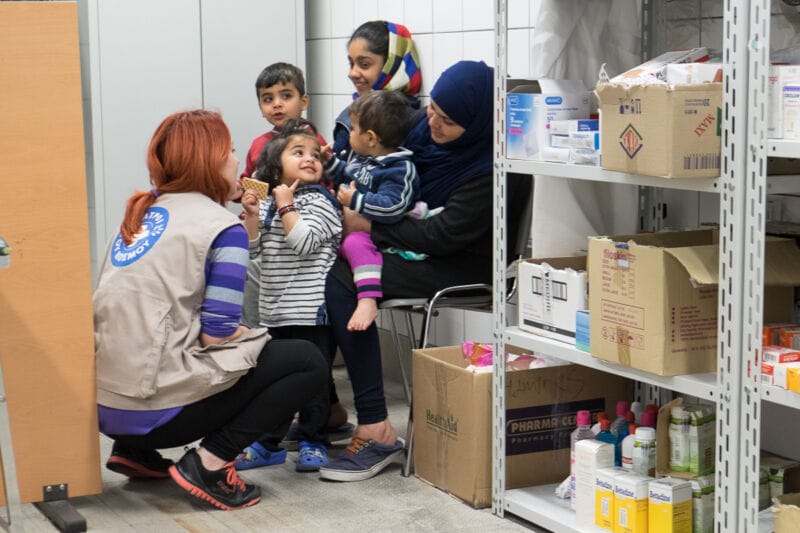
In responding to emergencies, numerous humanitarian actors are involved. We are talking about thousands of organizations. Some provide direct assistance to affected people, while others provide funding, support coordination mechanisms, or have more academic and research-oriented purposes.
These actors have emerged and evolved mainly over the course of the 20th and 21st centuries. All of them, at least in theory, adhere to the humanitarian principles, although there can be differences in how they interpret and apply some of them. Finally, they all collaborate and cooperate with one another in some way in responding to humanitarian crises.
Table of contents:
National and local authorities
Authorities of a country are the ones with primary responsibility for responding to a humanitarian crisis
It is often common, when thinking about humanitarian action, to think of the Red Cross, NGOs, or the United Nations. However, although these organizations play a fundamental role, it is the authorities of a country or territory (government, ministries, departments, etc.) that hold the primary responsibility.
According to the resolution agreed at the United Nations General Assembly in 1991, «each State has the responsibility, first and foremost, to take care of the victims of natural disasters and other emergencies occurring on its territory». The State must protect and address the humanitarian needs of the affected population. To this end, it must assume «the principal role in the initiation, organization, coordination, and implementation of humanitarian assistance within its territory» (UN General Assembly, 1991).
Actors involved in the humanitarian response to a crisis must recognize the responsibility and role of the State
When the magnitude of the emergency and the needs of the population exceed the response capacity of the affected country, international cooperation can be essential. In such cases, States should facilitate access for impartial organizations with strictly humanitarian purposes that can assist the victims (UN General Assembly, 1991). These humanitarian organizations can support the State in fulfilling its responsibility (Sphere Association, 2018), but also demand that it do so.
What should humanitarian organizations do when the State fails to adequately protect the population?
In many cases, and especially in conflict settings, the authorities fail to adequately protect the population, and they neither request nor permit the delivery of humanitarian assistance by other organizations. However, in any armed conflict, International Humanitarian Law obliges local authorities and all parties and armed groups involved in an armed conflict to guarantee the protection of the population under their control and its right to receive humanitarian assistance (ICRC, n.d.-a), as well as the freedom of movement of humanitarian personnel (ICRC, n.d.-b).
Therefore, humanitarian organizations must encourage and persuade the authorities controlling the various territories to fulfil their responsibilities, comply with International Humanitarian Law, and facilitate access for humanitarian organizations (Sphere Association, 2018). In many cases, when this persuasion does not work, some humanitarian organizations choose to provide assistance anyway, within a restricted humanitarian space and on contested legal grounds.
The United Nations agencies
Within the United Nations system, there are numerous specialized international organizations, funds, and programmes, generically known as United Nations agencies (United Nations, n.d.). Some of them include humanitarian functions in their mandate and are members of the Inter-Agency Standing Committee (IASC, n.d.). They are the following:
- Food and Agriculture Organization of the United Nations (FAO). Established in 1945, its mandate covers food security and access to sufficient, quality food.
- International Organization for Migration (IOM). Established in 1951, it became a related organization of the United Nations in 2016 and leads the protection of migrants and displaced persons.
- United Nations Development Programme (UNDP). Established in 1965, its work focuses on sustainable development, democratic governance, and resilience to climate change and disasters.
- United Nations Children's Fund (UNICEF). Established in 1946, UNICEF seeks to protect the rights of all children, providing and promoting education, health, and nutrition services.
- United Nations High Commissioner for Refugees (UNHCR). Established in 1950, UNHCR seeks to protect refugees, forcibly displaced people, and stateless persons.
- United Nations Human Settlements Programme (UN-Habitat). Established in 1978, its aim is to build inclusive, safe, resilient, and sustainable cities and communities.
- United Nations Population Fund (UNFPA). Established in 1967, UNFPA emerged in response to demographic change and evolved towards advocating for reproductive and sexual health and rights.
- UN Women. Established in 2010 to advance gender equality and the empowerment of women.
- World Food Programme (WFP). WFP was established in 1961 and works to provide food assistance in emergencies and to improve the resilience of food systems.
- World Health Organization (WHO). Founded in 1948, WHO is the UN agency dedicated to global health through health promotion, response to health emergencies, and the expansion of universal health coverage.
In addition to these agencies, there are two entities within the United Nations system that have a humanitarian role of their own without being operational funds or programmes:
- Office for the Coordination of Humanitarian Affairs (OCHA). It is a department of the United Nations Secretariat. It carries out its coordination function largely through the IASC, which it chairs.
- Office of the United Nations High Commissioner for Human Rights (OHCHR). Established in 1993, it is a standing invitee to the IASC for the role it plays in protection. It seeks to promote and protect the rights and freedoms set out in the Universal Declaration of Human Rights.
The United Nations agencies are not NGOs
All United Nations agencies were created by treaties or resolutions of the General Assembly. As a result, there are major differences between United Nations agencies and NGOs:
- The members of UN agencies are not individuals, but rather the member States, which are represented in their governing bodies.
- UN agencies have a mission that states their fundamental purpose, just as NGOs do. However, there is an important difference: this purpose is defined in a mandate conferred by States through treaties and resolutions. The mandate defines the agency's authority, functions, competencies, and responsibilities. In practice, the term "mission" is used for NGOs and the term "mandate" is reserved for UN agencies.
- The United Nations (UN General Assembly, 1946) and its agencies (UN General Assembly, 1947) enjoy a range of privileges and immunities that NGOs, by default, do not have. As a general rule, they cannot be sued before national courts or registered by national authorities without their consent. They benefit from financial and currency-exchange privileges, tax exemptions, and communication facilities. Moreover, their presence in a country does not depend on ordinary registration, which gives them autonomy in negotiations with governments.
Non-Governmental Organizations (NGOs)
Non-governmental organizations are non-profit entities that are independent of governmental power. However, they must obviously comply with the legal framework of the countries where they are established.
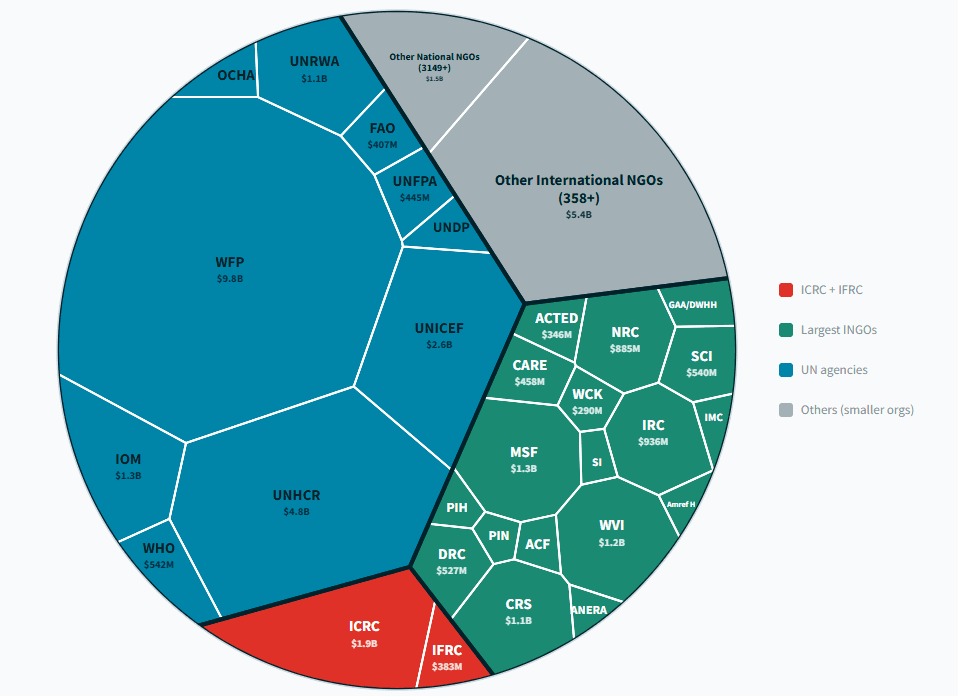
Under the umbrella of the term humanitarian NGO falls a vast range of organizations that can be difficult to categorize (Humanitarian Outcomes, n.d.). There are large and small ones, national and international ones, and religious and non-denominational ones, for example. Some rely heavily on volunteers, while others are entirely professional. There are NGOs with a purely humanitarian focus, as well as others that work in both fields or that have shifted from one to the other over the years. They can also take different legal forms, such as associations, foundations, or federations of both, for example. At times they come together in coalitions or consortia for specific projects and initiatives.
Local and national NGOs are often the first to respond. Moreover, they are embedded in their own communities and have access to the population in need of assistance. These organizations are usually already connected to existing local networks, and they understand the context, the challenges, and the possible solutions that may work. Many changes and reforms to the humanitarian system have been proposed in order to, among other things, give more control within it to local and national actors such as NGOs, though this has not yet been achieved.
International NGOs are registered and have offices in multiple countries (with some of their offices acting as headquarters for coordinating the rest). Some involved in humanitarian action are, for example, Doctors Without Borders (MSF), Doctors of the World, Action Against Hunger, Save the Children, International Rescue Committee (IRC), Danish Refugee Council (DRC), Catholic Relief Services (CRS), CARE International, World Vision, Relief International, Mercy Corps, Norwegian Refugee Council (NRC), Concern Worldwide, GOAL, Humanity & Inclusion, MedAir, InterSOS, People in Need, Alima, and Terre des Hommes, among many others.
The historical context that gave rise to each NGO largely shapes its identity and values
The first humanitarian NGO was Save the Children, founded in 1919, but most are much more recent.
Among the most long-standing is Médecins Sans Frontières, born in 1971 out of frustration with humanitarian silence in the face of atrocities. This largely defines the identity of a frontline medical organization that distances itself from silent neutrality towards atrocities and human rights violations, and that takes on greater operational risks than others. It also has a humanitarian funding model with a high degree of independence from governmental donors and, for years now, has participated less than other NGOs in the coordination mechanisms led by the United Nations.
Most NGOs that emerged and developed from the 1990s onwards did so in a context shaped by the end of the Cold War and the Rwandan genocide. Many of these organizations, despite also responding in emergencies and with a strong grounding in respect for the humanitarian principles, distance themselves from the earlier ones by having a rights-based approach and by aligning closely with technical standards and coordination mechanisms that emerged in this period.
Finally, there are the organisations born in the early years of the twenty-first century. Many of these NGOs (a large share of them national and local) emerged with a highly critical view of the humanitarian system within which they have been forced to develop, and whose foundations they see as postcolonial: a system controlled by United Nations agencies, in which Western NGOs dictate strategies and technical standards. They therefore call for greater localisation: the transfer of real power and humanitarian funding to communities and organised civil society in the countries where humanitarian crises occur. Among them are organisations such as ALIMA and NEAR. The former is an international medical NGO born in Niger, headquartered in Dakar and operating in more than twelve countries (Popoviciu, 2026), while the latter is a movement of Global South organisations driven forward since 2012 and launched in 2016 (Ali, 2026).
The tradition, organizational model, size, and funding of organizations also matter
The heterogeneity of NGOs depends not only on the historical moment when the organizations were born, but also on the place where they emerged or the values from which they evolved. In this sense, there are three main currents (Stoddard, 2003):
- A large group of NGOs are those of a religious tradition. This umbrella includes Catholic, evangelical, Jewish, and Islamic organizations, which combine social and religious goals.
- A second group, in which European organizations feature heavily, is characterized by having inherited the "Dunantist" values of the ICRC, named after its founder, Henri Dunant. Many have also traditionally been "rebellious" when it comes to accepting international standards and highly critical of attempts to politicize international aid, with a tendency towards advocacy as a means of achieving sustainable change and real transformation.
- A third group encompasses many US organizations under the "Wilsonian" tradition, inherited from a president of the United States: Woodrow Wilson. These organizations accept having strong ties to their government's foreign policy and funding. Their approach is generally more pragmatic.
There are more factors that account for differences between organizations, such as their size. There are large organizations in which much of the work consists of expanding their growth, raising the visibility of their brand, and trying to attract more funds and resources in order to provide more and better humanitarian assistance. Conversely, there are many small organizations that maintain very close proximity to and trust with the communities in which they work, which gives them a strong knowledge of the operational context.
The size of organizations is, in a way, also related to their tradition and funding model. Some organizations of the Wilsonian tradition have grown to reach large operational volumes thanks to US public funding (Stoddard, 2003). NGOs of the Dunantist tradition have traditionally sought more private funding and less dependence on public funding, in order to preserve greater operational freedom. In any case, the evolution of humanitarian funding and its sources has contributed to considerable heterogeneity, and to a dilemma that Dunantist organizations often face: how to grow and develop the operational capacity needed for an effective response in complex humanitarian settings while maintaining financial independence from governmental donors? (IRIN News, 2012)
The international Red Cross and Red Crescent movement
This enormous network is made up of the National Red Cross and Red Crescent Societies (e.g. the Spanish Red Cross or the Syrian Arab Red Crescent), the International Federation of these Societies (IFRC), and the International Committee of the Red Cross (ICRC) (Shahpar & Kirsch, 2018).
- The National Societies are auxiliaries to the public authorities in the humanitarian field, and their role is recognized by the national legislation of their countries. They are all brought together under the International Federation of Red Cross and Red Crescent Societies.
- The International Committee of the Red Cross, founded in 1863, is an independent humanitarian organization. It is defined by its relationship with international law and the specific legal mandate conferred on it by the Geneva Conventions and States. For this reason, it is strongly committed to strict neutrality, impartiality, and independence. In addition to its mandate in humanitarian assistance, it also promotes the humanitarian principles and international humanitarian law.
Is the Red Cross an NGO?
No. Although it is often perceived as a large NGO, the Red Cross and Red Crescent Movement is not an NGO. It occupies a category of its own (Shahpar & Kirsch, 2018).
The International Committee of the Red Cross does not confer its own purpose upon itself; rather, it has a mission entrusted to it by States through the Geneva Conventions. This mission includes functions that no other NGO could carry out, such as acting as a neutral intermediary between the parties to a conflict. The National Societies are, under the law of their own country, auxiliaries to the public authorities, and there can only be one per State.
The Red Cross and Red Crescent Movement is also not part of the United Nations system, although both the ICRC and the International Federation are standing invitees to the IASC.
Donors
Most humanitarian assistance is funded through voluntary contributions from governmental donors, channelled directly to other actors (such as United Nations agencies or NGOs) (Shahpar & Kirsch, 2018). The main public donors have traditionally been the United States, Germany, the European Commission, Japan, Sweden, Norway, the United Kingdom, Saudi Arabia, the Netherlands, France, Canada, and Switzerland.
These countries usually manage their international aid through governmental agencies. Some of these are the Directorate-General for European Civil Protection and Humanitarian Aid Operations (DG ECHO) of the European Commission, GIZ in Germany, GAC in Canada, AFD in France, AECID in Spain, SIDA in Sweden, JICA in Japan, and FCDO (formerly DFID) in the United Kingdom, among others. Until it was dismantled in 2025, the largest governmental international cooperation agency was the United States Agency for International Development (USAID).
Other donors such as the Asian Development Bank or the World Bank have expanded their funding to humanitarian responses only a few years ago. This has occurred within the framework of the humanitarian-development-peace nexus.
Other stakeholders
In addition to those mentioned above, there are many other actors to take into account. These include private companies, universities, regional organizations, intergovernmental forums and foreign military assets (FMA), among others.
As for the private sector, it has contributed to humanitarian action for years, at multiple levels (Binder & Witte, 2007). The recovery and functioning of local markets largely determine families' ability to access basic goods and continue their livelihoods after an emergency. National and international companies also make donations and form partnerships with humanitarian organizations for multiple purposes. Their greatest contribution lies in the transfer of new technologies and technical capacity in areas such as logistics, telecommunications, and cash transfers. Their role, however, becomes more complicated in sensitive and highly politicized conflict situations, where there is a greater risk that these actors' commercial interests may jeopardize the humanitarian principles precisely when they matter most (Zyck & Kent, 2014).
Within the private sector, it is also worth highlighting some large firms specializing in international consulting, such as Chemonics, DAI Global, Tetra Tech, Deloitte, and Palladium. For years they were major contractors for USAID, until its dismantling in 2025, although more in the field of development cooperation than in humanitarian action (Devex, 2023).
As for military actors, they often operate in the same environments where humanitarian organizations work, sometimes with a complicated and even problematic relationship. They are actors with very different objectives and approaches and, in a conflict, the motivations of military forces clash with the principles of neutrality and independence of humanitarian action. Nevertheless, on some occasions, the relationship between the two has made it possible to better protect the civilian population (Metcalfe et al., 2012).
References
- Ali, D. (2026, August 18). Build your own house — Part 1. Substack. https://deganali.substack.com/p/build-your-own-house
- Binder, A., & Witte, J. M. (2007). Business engagement in humanitarian relief: Key trends and policy implications (HPG Working Paper). Overseas Development Institute. https://odi.org/en/publications/business-engagement-in-humanitarian-relief-key-trends-and-policy-implications/
- Devex. (2023). Where the United States spends its development aid. https://pages.devex.com/rs/685-KBL-765/images/where-the-united-states-spends-its-development-aid_Sept23.pdf
- Humanitarian Outcomes. (n.d.). Global Database of Humanitarian Organizations. Retrieved July 16, 2026, from https://www.humanitarianoutcomes.org/gdho/search
- Inter-Agency Standing Committee. (n.d.). IASC membership. Retrieved July 16, 2026, from https://interagencystandingcommittee.org/about-inter-agency-standing-committee/iasc-membership
- International Committee of the Red Cross. (n.d.-a). Rule 55. Access for humanitarian relief to civilians in need. IHL Databases: Customary IHL. Retrieved 29 July 2026. https://ihl-databases.icrc.org/en/customary-ihl/v1/rule55
- International Committee of the Red Cross. (n.d.-b). Rule 56. Freedom of movement of humanitarian relief personnel. IHL Databases: Customary IHL. Retrieved 29 July 2026. https://ihl-databases.icrc.org/en/customary-ihl/v1/rule56
- IRIN News. (2012, April 12). Does private money buy independence? The New Humanitarian. https://www.thenewhumanitarian.org/report/95275/aid-policy-does-private-money-buy-independence
- Metcalfe, V., Haysom, S., & Gordon, S. (2012). Trends and challenges in humanitarian civil–military coordination: A review of the literature (HPG Working Paper). Overseas Development Institute. https://odi.org/en/publications/trends-and-challenges-in-humanitarian-civilmilitary-coordination/
- Popoviciu, A. (2026). ALIMA: The NGO doing things differently. The Lancet. Advance online publication. https://doi.org/10.1016/S0140-6736(26)01857-X
- Shahpar, C., & Kirsch, T. D. (2018). Who’s who in humanitarian emergencies. In D. Townes (Ed.), Health in humanitarian emergencies: Principles and practice for public health and healthcare practitioners (pp. 25–34). Cambridge University Press. https://doi.org/10.1017/9781107477261.004
- Sphere Association. (2018). The Sphere handbook: Humanitarian charter and minimum standards in humanitarian response (4th ed.). https://handbook.spherestandards.org/en/sphere/#ch001
- Stoddard, A. (2003). Humanitarian NGOs: Challenges and trends (HPG Briefing Paper No. 12). Overseas Development Institute. https://media.odi.org/documents/349.pdf
- United Nations. (n.d.). UN system. Retrieved July 16, 2026, from https://www.un.org/en/about-us/un-system
- United Nations General Assembly. (1946). Convention on the privileges and immunities of the United Nations. United Nations. https://www.un.org/en/ethics/assets/pdfs/Convention%20of%20Privileges-Immunities%20of%20the%20UN.pdf
- United Nations General Assembly. (1947). Convention on the privileges and immunities of the specialized agencies. United Nations. https://treaties.un.org/pages/ViewDetails.aspx?src=TREATY&mtdsg_no=III-2&chapter=3&clang=_en
- United Nations General Assembly. (1991). Strengthening of the coordination of humanitarian emergency assistance of the United Nations (Resolution 46/182). https://docs.un.org/es/a/res/46/182
- Zyck, S. A., & Kent, R. (2014). Humanitarian crises, emergency preparedness and response: The role of business and the private sector — Final report. Overseas Development Institute. https://odi.org/en/publications/humanitarian-crises-emergency-preparedness-and-response-the-role-of-business-and-the-private-sector-final-report/
NotebookLM
You can review my bibliographic references on humanitarian organizations with this Gemini Notebook, an AI-based research assistant. Want to know more?
How to cite this page
Abarca, B. (September 15, 2026). Humanitarian organizations: types, examples and how they work. Salud Everywhere. https://saludeverywhere.com/en/humanitarian-aid-and-international-development/humanitarian-organizations/