Humanitarian financing: sources, mechanisms and crisis of the model
- Page updated onMarch 15, 2026

How humanitarian action is funded (where it comes from, where it goes, and how it gets there) determines, to a large extent, the magnitude of the response that can be provided to crises and emergencies. Humanitarian funding mechanisms also largely determine how actions are developed, who implements them and many of the ethical dilemmas they will face.
However, humanitarian funding always falls short of covering all needs. This problem has worsened since 2023, and reached a catastrophic dimension since 2025, when cuts in humanitarian action budgets have plunged the sector into an unprecedented crisis.
Table of contents:
Where does the funding for humanitarian action come from?
Most of the humanitarian financing comes from voluntary contributions from donor countries
Traditionally, 80% of humanitarian financing has come from voluntary contributions from donor countries, through their international aid and cooperation agencies. The rest, around 20%, came from private donors: companies, foundations and individuals like you and me.
Among donor countries, there have always been significant disparities as well. If we look at the distribution of contributions, a few countries stand out above the rest. Between 2020 and 2024, on average, of all public funds for humanitarian crisis response, the United States contributed around 35.8%. They were followed at a good distance by Germany (11.6%), the European Commission (8.4%) and other donor countries such as Saudi Arabia (4.9%), the United Kingdom (4.7%), Japan (3.7%) or Sweden (3.1%).
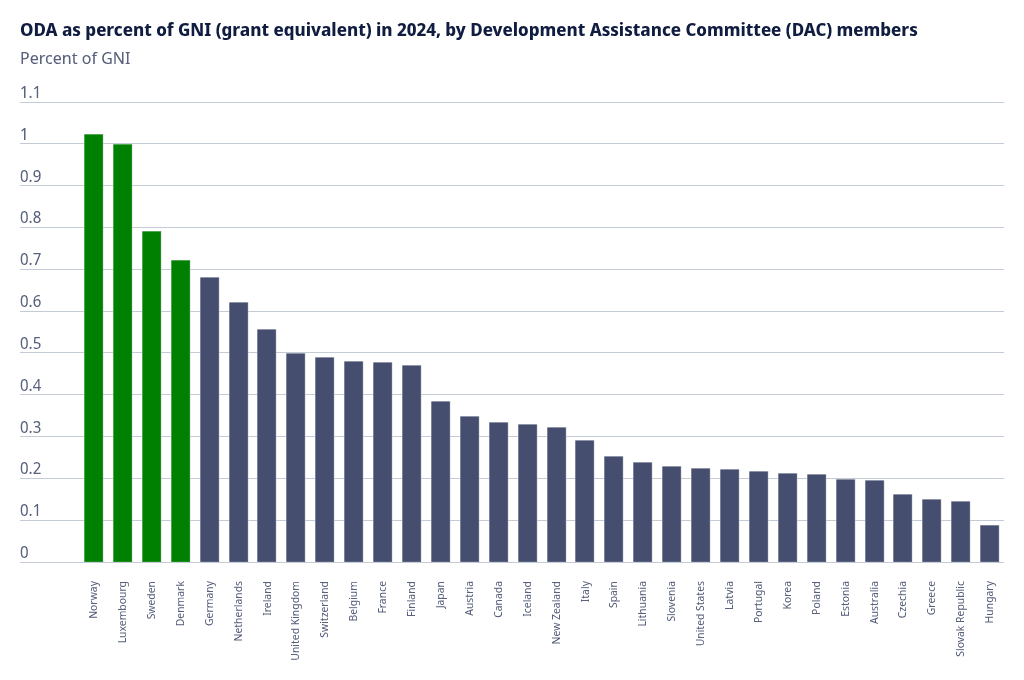
These contributions, in any case, represent a small percentage of Official Development Assistance (ODA) and an even smaller percentage of the gross national income of donor countries. Specifically, only between 12% and 18% of ODA is usually allocated to humanitarian action. In turn, in 2024, only four countries (Norway, Luxembourg, Sweden, and Denmark) devoted more than 0.7% of their gross national income to official development assistance (a voluntary commitment made in the 1970s by donor countries, but never achieved). Other donor countries, such as the United States, devoted only 0.23% of their GNI to foreign aid.
Humanitarian financing increased until the year 2022 and collapsed in 2025
The annual volume of humanitarian financing varies from year to year. In 2016 it stood at around $22.6 billion. Thereafter, this volume increased progressively until 2021, reaching $30.9 billion. Following this, the deteriorating crises in Ukraine, Afghanistan and East Africa resulted in a sharp reversal of the trend. In response to the increased humanitarian needs of the population, annual humanitarian funding reached an all-time high in 2022: $43.3 billion.
This trend, far from being sustained, changed rapidly. In 2023 and 2024 humanitarian funding fell to $37.1 billion, and in 2025 it collapsed, dropping to $24.6 billion. This sharp reduction in funding for global humanitarian action was the direct consequence of drastic cuts by several countries, most notably the United States. In just one year, this country went from contributing $14.1 billion to humanitarian action in 2024, to contributing only $3.4 billion in 2025; 75.8% less. Other countries also significantly reduced their contributions this year, such as Germany (57% less), the United Kingdom (48% less) and France (45% less).
Where does humanitarian funding go?
Donors can choose what their contributions are used for
The Office for the Coordination of Humanitarian Affairs (OCHA) of the United Nations and humanitarian country teams, with the support and participation of all humanitarian actors, publish key documents to guide resource mobilization and the prioritization of available humanitarian funding. These are Humanitarian Needs Overviews and Humanitarian Response Plans, along with their global versions.
Humanitarian donors are free to choose which countries, actors and interventions to target with their contributions. Generally, between 50% and 70% of humanitarian funding goes to projects aligned with the priorities of Humanitarian Response Plans, developed in a coordinated manner.
The contributions are not distributed proportionally to the needs of the different countries, nor are they sufficient to cover everything required by the coordinated plans. In 2024, for example, only 51% of what was requested in these plans was reached, and while in countries such as Lebanon, Ukraine or Sudan 70% was exceeded, in others such as Syria or Ethiopia not even 40% was reached. In 2025, moreover, and as a consequence of the drastic drop in humanitarian funding, barely 30% of what was required in the total of coordinated humanitarian response plans was achieved.
The contributions are sometimes delivered directly to implementing partners selected by the donors. In other cases, the international cooperation agencies of the donor countries manage open calls for projects, in which they indicate their priorities, requirements and eligibility criteria. To be eligible for these calls, humanitarian organizations must assess the needs of the population, identify the actions that are required to address them and reflect them in the proposal they submit. If they finally receive funding, they must use it for what they had indicated and justify it with reports, according to the donor's regulations. Between 80% and 90% of humanitarian funding is restricted (or earmarked) for use only on predefined projects.
Humanitarian funding also covers indirect costs of the organizations
Most humanitarian funding mechanisms allow a small percentage of the budget to cover indirect costs (overheads). Organizations need these overheads to cover structural costs, cope with risks or unexpected expenses, or prepare to respond to potential crises. The percentage allocated to these indirect costs is normally around 5-10%, although it depends on each organization and the agreements it reaches with donors.
When the organization that receives funding directly (and is responsible for its proper use and accountability) works with other actors who act as implementing partners, the funding of its indirect costs is negotiated between the two parties, donors permitting. On a case-by-case basis, implementing partners may receive additional contributions to cover their indirect costs, share the amount that is available with the main partner, or receive funding for direct costs only.
Of course, whether the funding of humanitarian organizations is direct or indirect matters a great deal. The possibility of covering indirect costs greatly influences the level of autonomy that NGOs are able to develop.
Which organizations are the direct recipients of humanitarian aid funds?
It is estimated that more than 60% of humanitarian funding goes directly to a UN Agency. In fact, the three humanitarian organizations that receive the most funding (World Food Program, UNHCR and UNICEF) were the direct recipients of approximately 40% of total annual humanitarian funding, between 2023 and 2025.
The remaining 39% of funding went directly to an international organization. The International Committee of the Red Cross received $1.812 billion, while the International Federation of Red Cross and Red Crescent Societies received $640 million. Many National Societies also received significant contributions. A few international NGOs such as Norwegian Refugee Council, Save the Children or International Rescue Committee received more than $300 million. Others such as Danish Refugee Council, Action Against Hunger, CARE international, Deutsche Welthungerhilfe, Mercy Corps and World Vision received between $100 million and $250 million. Most international NGOs, however, received much smaller contributions.
Only 1% went directly to local or national NGOs. While it is impossible to know how much total humanitarian funding ends up going to local NGOs, it is known that most of this funding goes to them indirectly. UN agencies and international NGOs that receive direct funding often sign contracts with other international and local NGOs, which act as implementing partners.
Part of emergency response funding goes to pooled funds managed by OCHA
These are the United Nations Central Emergency Response Fund (CERF) and the Country Based Pooled Funds (CBPF). Countries such as Japan and Sweden channel between 30% and 50% of their humanitarian funding through these funds, although their main donors are Germany, the United Kingdom and the Netherlands. Donor contributions to these funds are not earmarked to specific projects or organizations.
The CERF was established in 1991 and enhanced in 2005. It is a global fund managed by the Emergency Relief Coordinator (ERC) to respond rapidly to acute humanitarian crises or help finance humanitarian response in emergencies that have not received sufficient funding through other channels. Its amount was initially set at $50 million per year, but has progressively grown to $576 million by 2024. CERF can only fund UN agencies directly, although UN agencies can then subcontract international and national NGOs as implementing partners. In fact, about 25% of the CERF ends up being implemented by local NGOs.
Country-Based Pooled Funds (CBPF), on the other hand, are established when new humanitarian emergencies occur or existing ones deteriorate. They are managed by the country's Humanitarian Coordinator (HC) and are used to finance actions under the country's Humanitarian Response Plan or to respond to unforeseen emergencies. CBPFs reach more than 20 countries, with a combined total volume that peaked at $1.34 billion in 2022, although the figure dropped to $871 million in 2025. These funds can directly finance local NGOs, without intermediaries. In fact, the percentage of direct funding to local NGOs with these funds has increased from 26.3% in 2020 to 45.5% in 2025.
The lack of humanitarian funding, once worrying, is now critical and alarming
Even in the years with the highest funding, it has never been sufficient to cover humanitarian assistance needs caused by conflict, natural disasters or forced population displacement. The problem, moreover, has become more acute since 2022 and especially in 2025, with global humanitarian funding volume returning to 2016 levels.
The impact of this reduction in funding has been catastrophic, and examples of this are repeated around the globe. In 2025, two famines were declared (for the first time in a century) in Gaza and Sudan, and there were 25 million more people than the previous year who did not receive the humanitarian assistance they needed. In countries such as Syria, efforts to move from a protracted humanitarian crisis to a new phase of reconstruction and recovery were frozen due to lack of funds. At the same time, food rations for the Rohingya population in the world's largest refugee camp (Cox's Bazar in Bangladesh) were reduced by less than half. In Lebanon, UNHCR had to abruptly announce the end of coverage of hospitalization costs for refugees. 600,000 food insecure people in Mozambique were left without assistance. The scale of the crisis and its impact on the lives of those most vulnerable to it is difficult to summarize.
Regardless of cuts from other donor countries, the sudden cut in U.S. funding has wiped out the 40% of international humanitarian aid, almost instantaneously. The crisis, however, is not just financial. Emergency Relief Coordinator Tom Fletcher himself, Tom Fletcher, speaks of a crisis that is also moral and one of legitimacy in a time of global apathy, brutality, impunity and indifference, which has led to calls for an ambitious radical reform of the system (the humanitarian reset) and an aggressive hyper-prioritization of needs in the 2026 Global Humanitarian Needs Overview.
🧠 Let's pause and reflect
If humanitarian funding is conditioned by the geopolitical interests of those who provide it, can the humanitarian system be truly independent, and how could this structural dependence be reduced?
- 1 Think and write your answer.
- 2 Click on «Copy and open».
- 3 Paste to receive feedback.
📚 This is the NotebookLM for this topic. It uses only carefully selected references. | What is NotebookLM?
The 2025 humanitarian financial crisis has exposed other major chronic weaknesses in the model
It is not just a question of reduced funding. The critical widening of the gap between humanitarian needs and the money available to address them has exposed major flaws and limitations in the humanitarian funding model, its architecture and mechanisms.
Humanitarian funding has always been rigid and highly fragmented
Fragmentation of the system is a reality. Each donor country has its own mechanisms, procedures, priorities and deadlines for humanitarian funding. In addition, most calls for funding are for rapid response or have annual cycles and are tightly bounded to specific priorities, sectors, objectives and actions, defined in projects.
In most cases, the percentage of multi-year funding received by humanitarian organizations does not exceed 20% of their total (and is lower for NGOs and national and local actors). This generates a heavy workload for proposal formulation (of which only a portion is actually funded) and leaves little flexibility to plan coherent programs in protracted humanitarian crises or to adapt a project to a changing reality.
Humanitarian financing is unevenly distributed
On the one hand, and despite the humanitarian system's efforts to improve its coordination and the prioritization of needs-based humanitarian responses, donors continue to make a large part of their contributions according to geopolitical interests. Strategic alliances, cultural proximity or national security priorities of the most powerful governments dominate funding decisions, over humanitarian imperative and needs analyses.
On the other hand, the model prioritizes direct funding to large humanitarian actors, mainly UN agencies, ahead of international NGOs, and far ahead of national and local NGOs. This generates great inefficiencies and limits the autonomy and capacity of local NGOs, which barely manage to obtain funding indirectly, by being contracted as implementing partners. As a result, many local NGOs find it extremely difficult to sustain their basic structure, maintain the necessary capacity to identify and formulate new projects, and be able to continue competing in the next round of funding.
Previous humanitarian reforms have not achieved the changes that the model required
The 2016 Grand Bargain and its successive updates included among their reform commitments increased multi-year funding, unearmarked funding, and direct, quality funding targeted to national and local actors. The need to improve transparency, accountability, and traceability of aid was also highlighted.
However, progress has been slow and incomplete. Some donors have increased multi-year funding, but its availability (especially to local NGOs) remained limited even before the 2025 crisis. Similarly, improving aid flexibility remains a pending task.
These commitments were not met at the level expected in a decade of progressive increase in humanitarian funding. Now that the scenario has changed with a drastic reduction of funds and a hyper-prioritization of the most acute emergencies, priorities for new reforms also seem to have changed. Localization and strengthening and investing in Country-Based Pooled Funds seem to be key to the new agenda, as well as reducing duplication and bureaucracy, but multi-year funding takes a back seat.
At the same time, in the face of insufficient humanitarian funding, humanitarian actors are exploring alternative humanitarian financing mechanisms. These include debt-based options, loans and guarantees, which open up new possibilities, although there is skepticism about their potential and success is by no means guaranteed.
Are there innovative alternatives to traditional humanitarian funding models?
The problems with the humanitarian financing model did not emerge in 2025. They had already been studied and analysed for years. In parallel, attempts have been made to evolve towards new alternatives and their small-scale application. We are talking mainly about impact funds, insurance-based models, crowdfunding, and the application of public-private global funds for humanitarian action, as well as approaches to donors alternative to traditional Western donors, or through new narratives and messages.
Related blog articles:
However, none of these alternatives seems sufficient or truly alternative. Many are difficult to scale, and others are complex and remain out of reach for small and medium-sized organisations. Above all, they continue to depend on the voluntary contributions of public and private donors rather than on mandatory contributions, a far more reliable foundation.
Humanitarian system
NotebookLM
You can review my bibliographic references on humanitarian financing with this NotebookLM, an artificial intelligence-based research assistant. Do you want to know more?
Learning pathway
This page is part of: The heart of humanitarianism: foundations, ethics and current dilemmas.

How to cite this page
Abarca, B. (March 16, 2026). Humanitarian financing: sources, mechanisms & crisis of the model. Salud Everywhere. https://saludeverywhere.com/en/humanitarian-aid-and-international-development/humanitarian-financing/
External links
- OCHA. Financial Tracking Service.
- OCHA. Country-Based Pooled Funds.
- OECD. Official Development Assistance.
- United Nations. Central Emergency Response Fund.
- OCHA, 2025. Global Humanitarian Overview 2026.
- ALNAP, 2025. Global Humanitarian Assistance Report 2025.
- ALNAP, 2025. Humanitarian year in review: shocks and reverberations.
- Vigersky, 2025. The Great Aid Recession: 2025’s Humanitarian Crash in Nine Charts.
- IECAH, 2025. La acción humanitaria en 2024-25: un sistema en crisis, entre recortes, búsqueda de legitimidad y necesidad de reformas urgentes.
- Micheletti, 2025. The humanitarian movement’s Great Depression.
- MOPAN, 2025. Mapping of Multilateral Organisations’ Response to the Current Funding Environment.
- OCHA, 2025. Country-Based Pooled Funds and Regional Humanitarian Pooled Funds 2024 in Review.
- Humanitarian Funding Forecast, 2025. Underfunded Crisis Index.
- OCHA, 2025. Message from Emergency Relief Coordinator Tom Fletcher to the humanitarian community.
- Van Teutem, 2025. What is foreign aid? How “Official Development Assistance” is measured.
- Farber, 2024. Humanitarian Impact Finance: Instruments & Approaches.
- NRC, 2024. Catalogue of quality funding practices to the humanitarian response, 2nd edition
- Pearson, 2024. New money? What the numbers say about ‘non-traditional’ aid donors.
- ODI, 2024. Humanitarian Innovative Financing in fragile settings: Taking stock and charting the road ahead.
- ODI, 2024. Revitalising the Good Humanitarian Donorship Initiative: a 20-year review.
- OCHA, 2023. Country-based Pooled Funds Global Guidelines.
- Chapagain, 2023. The untapped potential of innovative financing and humanitarian organizations.
- IASC, 2022. Overhead cost allocation in the humanitarian sector.
- Grand Bargain Caucus on Quality Funding, 2022. Outcome document.
- IRC, 2021. Focus on the Frontlines: How the Grand Bargain can deliver on its promise to improve humanitarian aid.
- IRC, 2020. A win-win: Multi-year flexible funding is better for people and better value for donors.
- Good Humanitarian Donorship, 2018. 24 Principles and Good Practice of Humanitarian Donorship.
- Stoddard, 2017. Efficiency and inefficiency in humanitarian financing.
- Development Initiatives, 2017. Improving humanitarian transparency with the International Aid Transparency Initiative (IATI) and the UNOCHA
Financial Tracking Service (FTS).