Humanitarian coordination: OCHA, clusters & area-based coordination (ABC)
- Page updated onMarch 25, 2026

In the humanitarian system, a wide variety of organizations operate across multiple humanitarian contexts of high complexity. These actors need to have a predefined way of working in a coordinated manner, which everyone knows and respects from the onset of an emergency. Moreover, to be truly effective, humanitarian coordination mechanisms must ensure that all types of humanitarian actors feel included and represented within them, and that they are able to communicate in order to combine efforts toward a common objective. Otherwise, the risk of duplication of efforts and inefficiency is extremely high.
The humanitarian architecture has evolved over decades, reforming its coordination systems as practice has progressively revealed their limitations. In this regard, the most recent changes in humanitarian coordination have taken place in 2026, as part of the Humanitarian Reset, driven to address the humanitarian system crisis of 2025.
Table of contents:
The global framework for the coordination of humanitarian action, updated in 2026
OCHA, the Emergency Relief Coordinator, and the Inter-Agency Standing Committee
The current framework for the coordination of humanitarian assistance was established in 1991. That year, United Nations resolution 46/182 determined that each state had the responsibility to deal with victims of emergencies and disasters on its territory, including the initiation, organization, coordination and delivery of humanitarian assistance. However, it also determined that, when assistance needs exceed the capacity of states, states may request and should facilitate external international cooperation, which will act with the consent of the national authorities. International assistance should be provided under the coordination, cooperation and leadership of the United Nations.
There is a key figure in the United Nations, appointed by the Secretary-General himself. This is the Emergency Relief Coordinator (ERC). He/she reports to the General Assembly. It must respond to requests for humanitarian assistance, have an overview of all emergencies, facilitate humanitarian access to organizations, manage an emergency fund, lead the coordination and mobilization of humanitarian assistance, and promote the transition to post-emergency recovery. It has, at its service, the Office for the Coordination of Humanitarian Affairs (OCHA) of the United Nations.
The Emergency Relief Coordinator also chairs the Inter-Agency Standing Committee or IASC. It is the main global humanitarian coordination platform of the United Nations. It involves all UN operational agencies (FAO, IOM, OHCHR, OCHA, UNDP, UNICEF, UNHCR, UN-HABITAT, UNFPA, UN Women, WFP and WHO). In addition, there is a standing invitation to IFRC, ICRC, the World Bank and the Special Rapporteur on the Human Rights of Internally Displaced Persons. NGOs are also represented in the IASC, through three partnerships: InterAction, ICVA (International Council of Voluntary Agencies) and SCRH (Steering Committee for Humanitarian Response).
The humanitarian cluster system
Throughout the 1990s and early 21st century, a series of humanitarian crises demonstrated the need for an even more structured system for humanitarian operations. When humanitarian crises were large, the humanitarian system proved inefficient, with duplication of some efforts and simultaneous gaps in response. In 2005 Jan Egeland, the Emergency Relief Coordinator, commissioned an independent evaluation. One of the main findings of this evaluation was to propose the current cluster approach.
A cluster is a group of humanitarian agencies and organizations specialized in a specific sector of the humanitarian response. Each cluster has a lead agency. However, at the global level, these humanitarian clusters do not directly implement actions. Rather, their role is one of coordination and leadership, to strengthen the technical capacity for preparedness and response to humanitarian emergencies within their area of expertise. They also provide operational support to national clusters.
New humanitarian clusters in 2026
Until 2025, there were eleven clusters. Six of them covered traditional technical areas: water, sanitation and hygiene (WASH), shelter, nutrition, health, food security, and education. Two others covered service-related areas: logistics and emergency telecommunications. A further three addressed cross-cutting issues: camp coordination and camp management (CCCM), early recovery, and protection.
In 2026, in line with the Humanitarian Reset, the IASC has simplified the system to 8 clusters: nutrition; protection; shelter, land, and site coordination (SLSC); water, sanitation and hygiene (WASH); education; food security; health; and logistics and telecommunications.
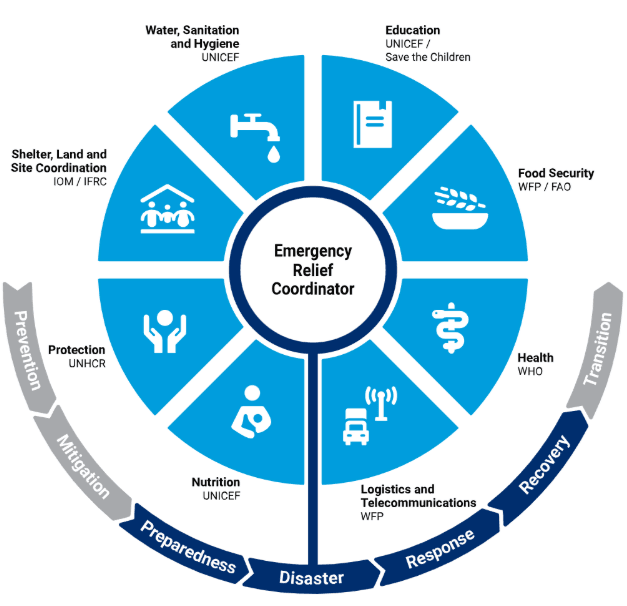
Thus, the Protection cluster now integrates the areas of responsibility related to gender-based violence, child protection, and mine action. The global leadership of this cluster rests with UNHCR, while UNFPA, UNICEF, and UNMAS retain technical responsibilities and act as providers of last resort within their respective areas. The new Shelter, Land, and Site Coordination (SLSC) cluster merges two of the previous clusters into a single structure, led by IFRC and IOM. Logistics and telecommunications have also been consolidated into a single cluster. Finally, the Early Recovery cluster is expected to be phased out by the end of 2026, as part of a transition toward development actors. The remaining clusters from the previous model continue unchanged.
National humanitarian coordination: humanitarian country team, clusters, area-based coordination (ABC) and local co-coordination
The architecture of global humanitarian coordination is reflected in national and regional humanitarian crises.
The Humanitarian Coordinator, and the Humanitarian Country Team
Similar to the global model, when a humanitarian emergency arises in a country that requires it, the ERC appoints a Humanitarian Coordinator (HC). On occasion, or until a HC is appointed, this role is assumed by the UN Resident Coordinator in that country. The Humanitarian Coordinator is supported by the Emergency Relief Coordinator and OCHA, and is responsible for leading and coordinating the action of humanitarian organizations in the country, so that it is based on humanitarian principles, is timely, effective and efficient, and contributes to long-term recovery.
At the onset of a humanitarian crisis, and similar to the global role of the IASC, a Humanitarian Country Team (HCT) is established in the affected country or region. This team is chaired by the Humanitarian Coordinator and is responsible for determining the other humanitarian coordination structures. The Humanitarian Country Team includes representation from national authorities (government) and NGOs, in addition to cluster leaders from each sector (if any). The HCT is also usually supported by other mechanisms, such as coordination groups between the different clusters or sectors, and working groups for information management. All these actors together coordinate and lead the activation of the response and the humanitarian country program cycle.
Humanitarian clusters are also established (or activated) at the national level
When necessary, and based on the Humanitarian Country Team’s analysis of humanitarian needs and national coordination capacity, humanitarian clusters are activated at the country level. Not all clusters are automatically activated in every response. Instead, an assessment is first made of the scale of the crisis, the limitations of existing coordination mechanisms, the need for a multisectoral approach, and the complexity of the response in terms of the number and diversity of humanitarian actors involved. This process should take place within the first 72 hours from the onset of the emergency.
The usual practice is for the same agency that leads the cluster at the global level to also lead the national cluster, but this is not always possible or appropriate. In a given country there may be organizations that are better positioned to assume this role. Sometimes co-leadership by the local authority or an NGO is also considered. Each cluster is supported by its counterpart global cluster. There may also be mechanisms and working groups for coordination between clusters, beyond the Humanitarian Country Team.
Once activated, the clusters act as formal forums for humanitarian coordination by sector, at the national level. Thus, the cluster assumes coordination responsibilities among all actors working in its sector. These responsibilities include supporting service provision (avoiding unnecessary duplication) and guiding operations, strengthening local authorities, and informing the Humanitarian Country Team's operational and advocacy decision making as it relates to their sector. Their role is key to developing sector strategies in a coordinated manner, supporting the different actors and facilitating their collaboration. Clusters can also establish working groups on specific themes in their sector. All humanitarian actors working in a country in, for example, the health sector, are invited to participate in their health cluster, which meets regularly.
In 2026, a new local architecture is introduced: Area-Based Coordination (ABC)
One of the main innovations of the 2026 humanitarian reform is the Area-Based Coordination model. This is a light operational coordination model designed for a specific subnational geographic area. In these settings, this coordination approach facilitates the response and the delivery of services.
ABC does not replace clusters; rather, both systems are complementary. Although much remains to be defined regarding the practical implementation of this complementarity, both coordination models are expected to coexist, adapting to the operational needs of each humanitarian context.
In 2026, the leadership and accountability of local NGOs in humanitarian coordination is further strengthened
National and international NGOs have never been mere project implementers. They have also played an active role in ensuring that humanitarian action is coordinated and effective. Traditionally, their participation has been promoted and facilitated, for example, by recommending that clusters be co-led by an NGO, to enhance coordination and contextualization of the response.
By 2026, however, the humanitarian system has evolved from simply recommending participation to establishing the co-leadership and co-coordination of local and national actors as the default standard within clusters and area-based coordination (ABC) mechanisms. It is important to clarify, however, that the role of Cluster Co-Coordinating Partner (CCP) allows local organizations to lead operational decision-making without forcing them to assume the responsibility of being providers of last resort. The ultimate responsibility for covering critical humanitarian assistance gaps continues to rest with the Cluster Lead Agency (CLA). This responsibility can be shared with another co-lead agency if it is established, exceptionally, in a specific agreement.
In addition, national and international NGOs often establish forums and networks among themselves, which at times play an additional key role in humanitarian coordination. These forums are often supported by international NGO networks such as InterAction, ICVA, or SCHR. NGO forums have been reaffirmed as a key element in facilitating coherence between formal global humanitarian coordination systems and national-level mechanisms, as well as in providing technical support to NGO leaders.
Humanitarian coordination in special situations
Coordination in refugee camps
In refugee contexts where humanitarian assistance is required, the organization with the mandate to protect these people and coordinate the response among actors is UNHCR. Displaced persons have specific protection needs that must be addressed and, as such, UNHCR cannot transfer this mandate to another organization such as OCHA. UNHCR furthermore monitors and ensures that states adhere to standards for the protection of refugees.
In major refugee crises, instead of establishing a Humanitarian Response Plan, a Refugee Response Plan, national or regional (when the crisis extends to several countries), is articulated. The general framework for these plans is the Global Compact on Refugees. In the coordination model for these contexts, no clusters are established.
In addition, there are mixed situations, where there is a humanitarian response for which a Humanitarian Coordinator has been appointed and also an ongoing UNHCR operation. In such cases, an agreement signed between OCHA and UNHCR in 2014 establishes the roles of each organization and the mechanism for collaboration between them.
Coordination in health emergencies
The experience of humanitarian response in crises with large epidemics (such as Ebola or COVID-19) has shown that the coordination model requires some changes. The IASC has developed specific procedures for these cases, thus linking the role of the usual humanitarian coordination mechanisms with the responsibilities of the World Health Organization under the International Health Regulations.
In these cases, the Emergency Relief Coordinator works in collaboration with the WHO Director-General. Thus, WHO provides an assessment of the situation, the public health risks, and the need to activate a wide-ranging humanitarian response. The coordination model can be adapted taking into account existing resources and coordination platforms.
🧠 Let's pause and reflect
When a State has primary responsibility for the victims of an emergency on its territory but lacks the capacity to respond, under what conditions should it cede leadership of coordination to international actors, and who should make that decision?
- 1 Think and write your answer.
- 2 Click on «Copy and open».
- 3 Paste to receive feedback.
📚 This is the NotebookLM for this topic. It uses only carefully selected references. | What is NotebookLM?
Humanitarian coordination often has much room for improvement
Much has been said about humanitarian coordination. Moreover, successive reforms have changed and updated the model. In general, these changes have been welcome and have improved how the different actors collaborate with each other. However, not everything depends on regulations and procedures. After all, most coordination mechanisms also depend on the will to collaborate between humanitarian actors who, at the same time, compete for scarce resources and must manage their own priorities in very complex contexts. Moreover, it is not easy to effectively coordinate these actors, and even more so when teams are frequently renewed and do not always have sufficient experience in similar tasks.
Some studies have shown that, on occasions, in Humanitarian Country Teams meetings there are no open, participatory, action-focused discussions. Sometimes there is not an adequate climate of participation and trust in these mechanisms, in which there is much asymmetry between the power and voice of UN agencies, international NGOs and national NGOs. Moreover, they do not all address important humanitarian principles such as independence in the same way. As a result, organizations may tend to ignore meetings, not actively participate in them, hide information that may compromise them, or avoid addressing particularly sensitive issues. It is not uncommon that at the end of some of these meetings, their participants have the feeling that everything has been limited to sharing the same information that could have been circulated in an email.
Time will tell whether the new humanitarian coordination reforms introduced in 2026 will help to overcome these problems.
Humanitarian system
NotebookLM
You can review my bibliographic references on humanitarian coordination with this NotebookLM, an artificial intelligence-based research assistant. Do you want to know more?
How to cite this page
Abarca, B. (March 25, 2026). Humanitarian coordination: OCHA, clusters & area-based coordination (ABC). Salud Everywhere. https://saludeverywhere.com/en/humanitarian-aid-and-international-development/humanitarian-coordination/
External links
- IASC, 2026. Cluster Simplification and Adapting In-Country Coordination.
- IASC, 2026. Lead and accountability arrangements for consolidated clusters.
- IASC, 2026. Standard Terms of Reference for Area-Based Coordination.
- IASC, 2026. Country-level Cluster Terms and Definitions.
- IASC, 2024. Leadership in Humanitarian Action: Handbook for Humanitarian Coordinators.
- ICVA, 2024. Cracks in Coordination: Trust and Engagement in Humanitarian Country Teams.
- IASC, 2021. IASC Guidance on Strengthening Participation, Representation and Leadership of Local and National Actors in IASC Humanitarian Coordination Mechanisms.
- IASC, 2019. Standard Operating Procedure. Humanitarian System-wide Scale-up Activation Protocol for the Control of Infectious Disease Events.
- United Nations, 2018. Global Compact on Refugees.
- IASC, 2017. Standard Terms of Reference for Humanitarian Country Teams.
- ICVA, 2017. Demystifying Humanitarian Coordination.
- OCHA y UNHCR, 2014. Joint UNHCR – OCHA Note on Mixed Situations: Coordination in Practice.
- Humphries, 2013. Improving Humanitarian Coordination: Common Challenges and Lessons Learned from the Cluster Approach.
- IASC, 2012. Reference Module for Cluster Coordination at the Country Level.
- IASC, 2006. Questions and Answers on the Cluster Approach Implementation Issues.
- United Nations, 2005. Humanitarian Response Review.
- United Nations, 1991. Strengthening of the Coordination of Humanitarian Emergency Assistance of the United Nations. A/RES/46/182.